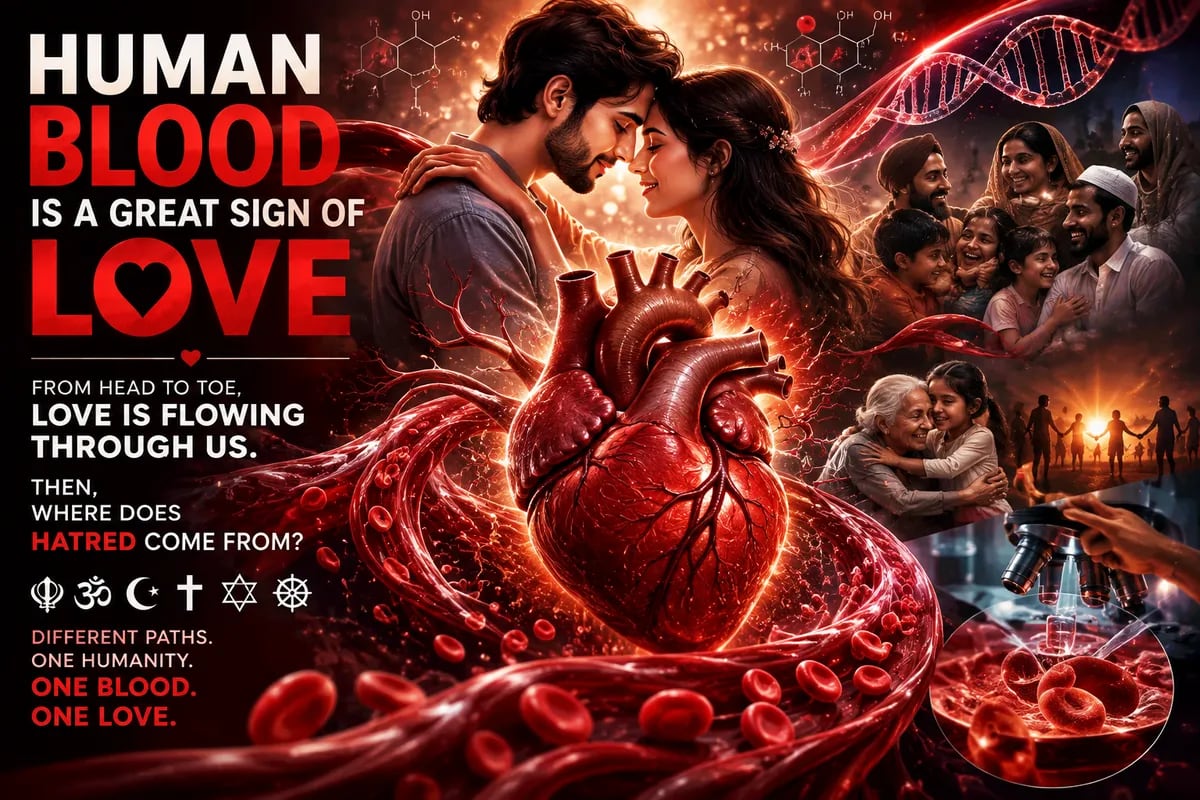
Your Blood Has No Religion
You were not born hating anyone.
So who taught you?
Think about the first moment of your life.
You had no passport.
No political party.
No religious argument.
No national flag.
No list of enemies.
You had a heartbeat.
You had blood.
You needed warmth.
You needed food.
You needed love.
That was your beginning.
And that beginning tells us something powerful about being human.
Dua For Halal Rizk.
https://youtu.be/OuH0E3kwroA?si=oEjCaholF6YNQBI5
We spend our lives drawing lines between people. We say this is my country. This is my religion. This is my group. These are our people. Those are their people.
But go inside the human body.
Look at the blood.
It does not know your religion.
There is no Muslim blood cell.
There is no Christian blood cell.
There is no Hindu blood cell.
There is no Jewish blood cell.
There is human blood.
The labels come later.
The divisions come later.
The stories come later.
So here is the question that should stop us in our tracks:
If human life begins with such a deep connection, where does hatred begin?
Where does the child learn to fear another human being?
Where does one human heart decide that another human heart is an enemy?
Before Love Had a Name
Human life begins through an extraordinary biological process.
During the menstrual cycle, hormones prepare the female reproductive system for a possible pregnancy. Around ovulation, an egg is released from an ovary. If sperm meets that egg and fertilization takes place, a new stage of human development begins.
Science gives us the language of cells, hormones, chromosomes and fertilization.
Human beings give this process another language.
We call it intimacy.
We call it family.
We call it love.
A human being enters the world through a story of connection.
And then we grow.
We learn language.
We learn culture.
We learn religion.
We learn history.
We learn who our people are.
We also learn who we are supposed to fear.
That is where the story becomes dangerous.
Hatred Does Not Flow Through Your Blood.
Hatred is not sitting inside your veins waiting to come out.
Fear can be learned.
Prejudice can be learned.
Suspicion can be learned.
And human beings can also learn compassion, forgiveness and kindness.
A small child can play with another child without asking about religion first.
They can laugh together.
They can share food.
They can fall down together and help each other stand.
Then someone teaches them a label.
Someone says, “Those people are different.”
Then another person says, “Do not trust them.”
The child listens.
The message is repeated.
The stranger slowly stops looking like a human being.
He becomes a label.
This is how distance grows.
Not inside the blood.
Inside the mind.
And once we understand that, we can begin changing the story.
The First Love Therapy: Meet the Human
Do this.
Find someone whose background is different from yours.
Talk to them.
Do not try to defeat them.
Do not prepare an argument.
Do not try to prove that you are smarter.
Ask one simple question:
“Tell me your story.”
Then listen.
Really listen.
Research on contact between different groups has found that positive contact can reduce prejudice in many situations.
This makes sense.
It is difficult to hate a human being you have actually come to know.
The stranger becomes a father.
A mother.
A brother.
A sister.
A worker.
A dreamer.
A person carrying private pain that you cannot see.
Put down the label.
Meet the person.
The Second Love Therapy: Compassion
Stop for a moment.
The next time you see someone suffering, do not ask first:
“What group are they from?”
Ask:
“What might they be carrying inside?”
Maybe they are afraid.
Maybe they are grieving.
Maybe they are raising children alone.
Maybe they are fighting a battle nobody knows about.
Compassion begins when we become curious about another person's pain.
Research on compassion training has found promising effects on empathy and prosocial behaviour.
You do not need a laboratory to begin.
Start today.
When someone is hurting, become a little gentler.
That is where love becomes real.
The Third Love Therapy: Forgiveness
There is another kind of prison.
It has no walls.
It is resentment.
Someone hurts you.
You remember it.
You replay it.
You become angry again.
And again.
And again.
Forgiveness does not mean saying that the wrong action was acceptable.
It does not mean forgetting injustice.
It does not mean allowing someone to hurt you again.
Forgiveness means refusing to let an old wound own your future.
Research on forgiveness interventions has found improvements in areas such as anger, hostility and emotional distress.
So ask yourself:
How long will you carry the person who hurt you inside your heart?
Forgive where you can.
Heal where you can.
Protect yourself where necessary.
But do not build your entire future around yesterday's pain.
The Fourth Love Therapy: Listen
Most people listen while preparing their answer.
Do something different.
Listen to understand.
Give another person ten minutes.
Ten minutes.
Close your argument.
Open your ears.
Let them finish.
Ask:
“What made you believe this?”
That question can change a conversation.
You may still disagree.
That is okay.
Love does not require everyone to think exactly alike.
Human dignity comes before agreement.
The Fifth Love Therapy: One Small Act
Do not wait for a world leader to create peace.
Start with your own hands.
Feed someone who is hungry.
Call someone who is lonely.
Help someone who is struggling.
Speak gently to the person you normally ignore.
Give someone your time.
A small act may look tiny to you.
To another person, it may become the brightest part of their day.
Love becomes powerful when it moves from words into action.
The Quran Gives Us a Different Way to See Difference
The Quran says:
يَا أَيُّهَا النَّاسُ إِنَّا خَلَقْنَاكُم مِّن ذَكَرٍ وَأُنثَىٰ وَجَعَلْنَاكُمْ شُعُوبًا وَقَبَائِلَ لِتَعَارَفُوا
“O mankind, We created you from a male and a female, and made you into peoples and tribes so that you may know one another.”
Quran 49:13
Look at that message.
Peoples.
Tribes.
Different identities.
But the purpose is to know one another.
Not to destroy one another.
Not to dehumanize one another.
To know one another.
That is a powerful idea for a divided world.
The Revolution Will Begin With a Conversation
The next great revolution does not have to begin with shouting.
It can begin at a dinner table.
Two people sit together.
They have different backgrounds.
They have different beliefs.
They have different stories.
But they decide to listen.
One asks:
“Tell me about your life.”
The other answers.
A wall becomes smaller.
A stranger becomes familiar.
Fear loses some of its power.
That is how change begins.
One conversation.
One act of compassion.
One act of forgiveness.
One moment of listening.
One decision to see a human being before seeing a label.
And then another person does it.
Then another.
Then another.
This is how love becomes bigger than hatred.
One Heart. One Blood. One Chance.
Look at your hands.
Look at your heartbeat.
Look at the life moving through your body.
You were born needing love.
So do not spend your life becoming a source of hatred.
You do not have to love every opinion.
You do not have to agree with every belief.
You do not have to forget every injustice.
But you can choose how you treat the human being standing in front of you.
Choose to listen.
Choose compassion.
Choose forgiveness.
Choose dignity.
Choose courage.
Choose love.
Not because the world is already peaceful.
Because the world needs people who are willing to make it more peaceful.
Your blood does not know religion.
Your heartbeat does not carry a passport.
Your tears do not ask for a nationality.
Under every label is a human life.
One heart.
One blood.
One chance.
Do not waste it.