

Husayniyat vs Yazidiyat: The War Inside Every Breath.
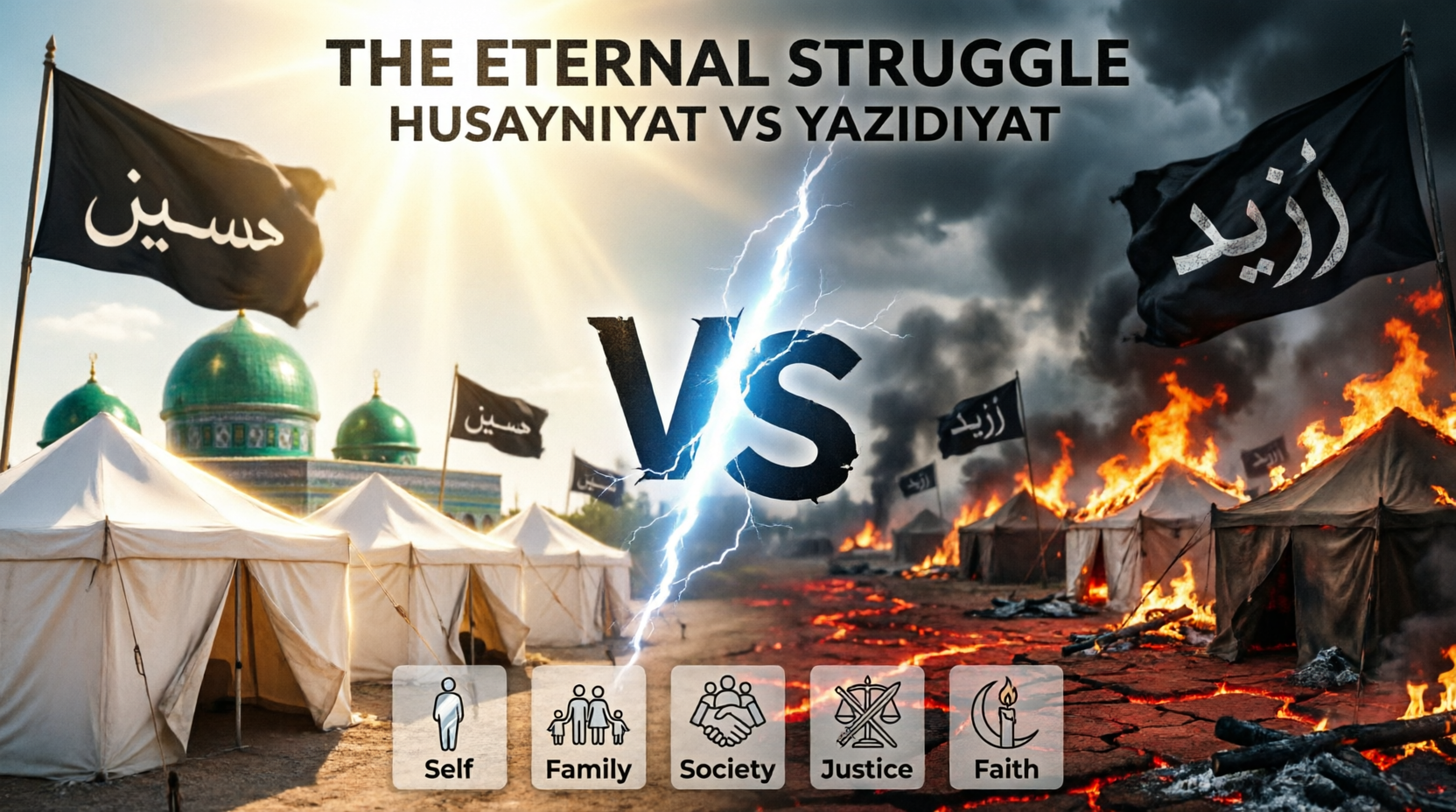
Ten Muharram is here again. Every year on this day, the world remembers Karbala. But if Karbala only stays a memory, we have missed the point. Karbala is not a story that happened once. It is a war that happens every single second, in every human being who is alive right now. This war has a name on each side. One side is called Husayniyat. The other side is called Yazidiyat.
What is Husayniyat?
Husayniyat is the spirit of Imam Husayn. It is not a religion only for one group of people. It is a way of standing in this world. Husayniyat means truth even when truth is alone. It means dignity even when dignity costs everything. It means saying no to power when power is wrong, even if you are the only one saying no. Husayniyat is sacrifice without complaint. It is love without condition. It is standing for the weak even when the whole crowd has gone silent.
What is Yazidiyat?
Yazidiyat is the opposite spirit. It is the spirit of Yazid. Yazidiyat means power without conscience. It means doing whatever benefits you, no matter who gets hurt. It is the comfort of staying silent when you should speak. It is choosing the easy lie over the hard truth. It is pride that refuses to bend even when bending is right. Yazidiyat is not always loud or violent. Sometimes it is very quiet. It can look like a small compromise, a small selfishness, a small silence. But it grows.
A war every second.
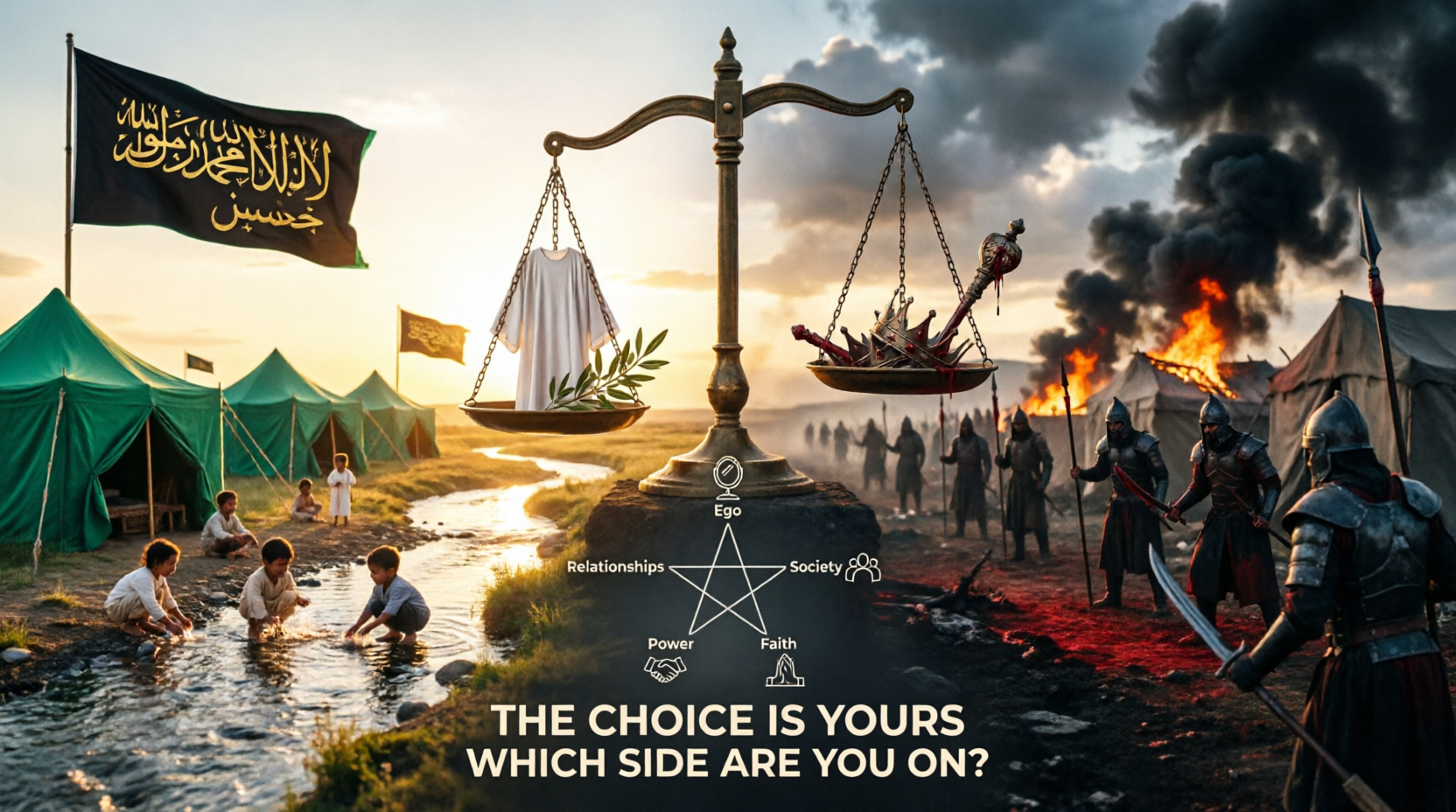
Here is the real point. This war between Husayniyat and Yazidiyat does not happen once a year on Ashura. It happens every second, all day, every day, everywhere in the world. Think about your own breathing. Air goes in, air comes out. It never stops, not for one second, as long as you are alive. This war is exactly like that. It never pauses. While you read this sentence, somewhere a person is choosing truth, and somewhere a person is choosing a lie. Somewhere someone is standing for justice, and somewhere someone is staying silent out of fear. Multiply that by every second of every day, by every person on earth, and you will understand the scale of this war. It is endless because life itself is endless, breath after breath, day after day.
So the real question for us, today, is not just "what happened at Karbala." The real question is: where is Yazidiyat hiding right now in our lives, and how do we defeat it? Where can Husayniyat be born again, right now, today? Let us go place by place.
Inside the human being.
Yazidiyat starts inside us before it ever reaches the outside world. It lives in our ego, our fear, our laziness, our love of comfort. When a person knows the truth but stays quiet because speaking is inconvenient, that is Yazidiyat living inside them. When a person sees someone suffering but looks away because helping is difficult, that is Yazidiyat too.
How do we kill it and bring Husayniyat to life inside ourselves? It starts with one small decision repeated again and again: choose the harder right thing over the easier wrong thing. Every time you tell the truth when a lie would be easier, you are practicing Husayniyat. Every time you control your anger instead of hurting someone with it, you are practicing Husayniyat. It is not one big dramatic moment. It is a thousand small moments, every single day, where you choose courage over comfort.
Inside the home
Now bring this into the home. A home can carry Yazidiyat without anyone noticing. It looks like a father who never listens, only orders. It looks like a mother who is never heard, only obeyed. It looks like elders who use fear instead of love to control the younger ones, or children who lie to their parents to avoid a hard conversation. Silence that should be a conversation, ego that should be humility, control that should be care — that is Yazidiyat sitting quietly inside four walls.
Husayniyat enters the home the moment someone decides to listen instead of order, to forgive instead of punish, to speak softly instead of using fear. A home becomes Husayni when every person in it, big or small, is treated with dignity, when mistakes are corrected with patience, not humiliation. This is not a small thing. The home is the first Karbala every child witnesses. What they see there, they will repeat outside.

Inside relationships
The same war lives inside marriage and inside every relationship between a husband and a wife, or between any two people who depend on each other. Yazidiyat in a relationship looks like control disguised as love. It looks like keeping score, punishing with silence, using someone's weakness against them. It looks like wanting to win an argument more than wanting to protect the relationship.
Husayniyat in a relationship is choosing the other person's dignity even when you are angry. It is saying "I was wrong" first. It is staying loyal not because it is easy, but because loyalty itself is the test. Husayn did not abandon his companions even facing death. A husband or wife who refuses to abandon their partner during the hard, unglamorous seasons of life is living a small Karbala of their own, and winning it.
Inside justice
Now look at justice, in courts, in workplaces, in any place where power decides someone's fate. Yazidiyat in justice looks like bending the rules for the powerful and breaking the powerless under the same rules. It looks like a judge, a boss, or a leader choosing what protects their position over what protects the truth. It looks like punishing the small mistake of a weak person while excusing the huge mistake of a strong one.
Husayniyat in justice is simple to describe and hard to live: treat every person the same, regardless of their power or your fear of them. It is standing up for someone who cannot stand up for themselves, even when standing up for them puts you at risk. Husayn stood against the most powerful ruler of his time with almost no army behind him. That is the model. Justice does not need numbers on its side. It needs courage.
Inside business
Finally, look at business, because this is where Yazidiyat hides most comfortably today. It looks like cheating a customer because they will never find out. It looks like underpaying a worker because they have no other choice. It looks like breaking a promise because the contract technically allows it. Profit without conscience is Yazidiyat wearing a suit.
Husayniyat in business is keeping your word even when breaking it would make you richer. It is paying people fairly even when you could pay them less. It is choosing honesty even when a small lie would close the deal faster. A business built this way may grow slower, but it grows on solid ground, and solid ground does not collapse.
The conclusion: how Husayniyat wins, every second.
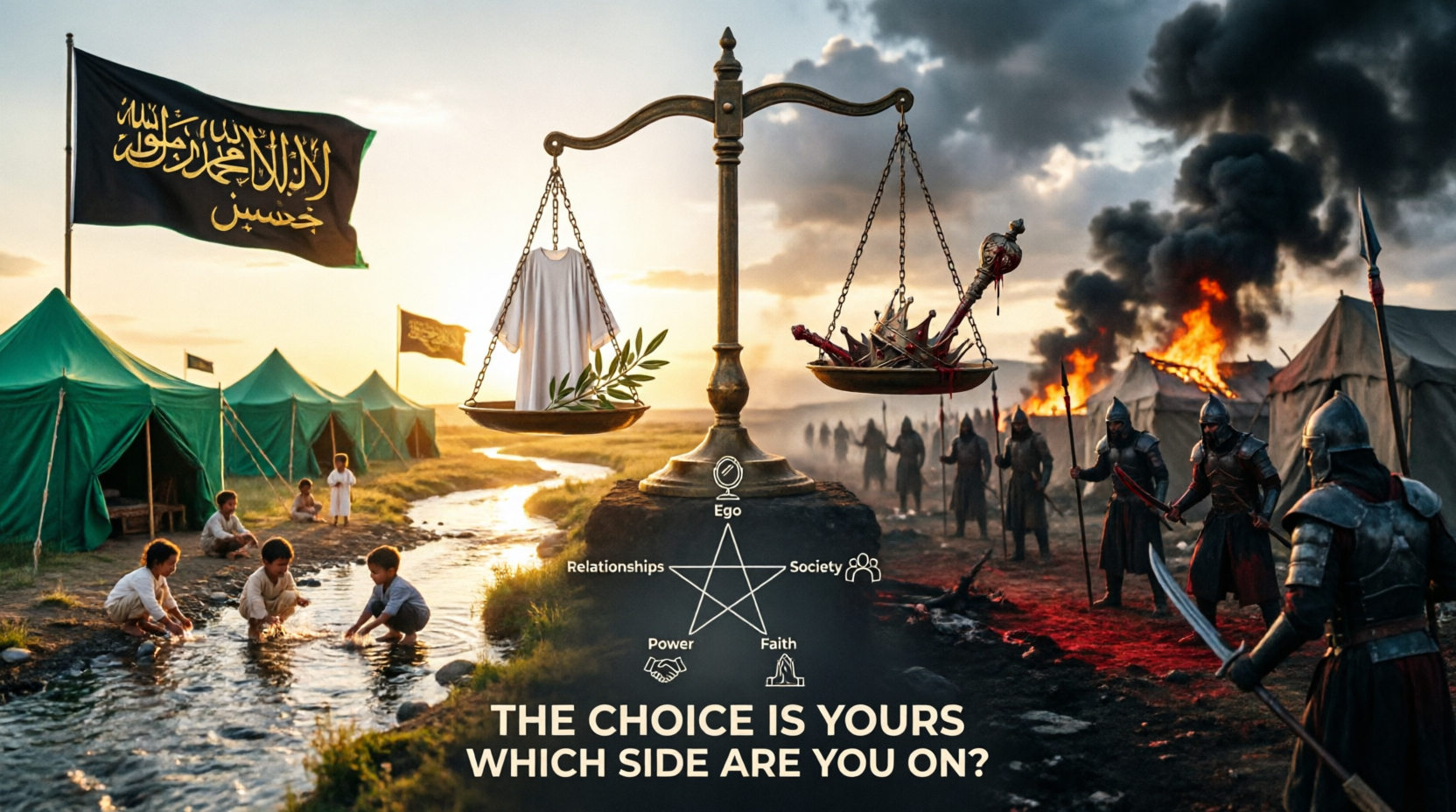
So here is the real lesson of Ashura, and it is not only history. Husayniyat does not win once a year on the tenth of Muharram. It has to win every second, in every breath, in every heart, in every home, in every relationship, in every courtroom, in every business deal. The war between Husayniyat and Yazidiyat is happening right now, inside you, as you read this.
How does Husayniyat win?
Not through one grand act, but through a chain of small, honest choices made again and again, second after second, the same way breath follows breath without ever stopping. Every time a person chooses truth over comfort, courage over fear, dignity over power, Husayniyat wins one more second of this endless war. And the beautiful part is this: even a child not yet born into this world will inherit this same war the moment they take their first breath. The chance to choose Husayniyat over Yazidiyat will be waiting for them too, fresh and new, exactly as it is waiting for you right now, in this very second.
That is the real meaning of Karbala. Not a memory to visit once a year,
but a battle to win every single second we are alive.
Comments (0)
Please sign in to join the conversation.
No comments yet. Be the first to join the discussion!