
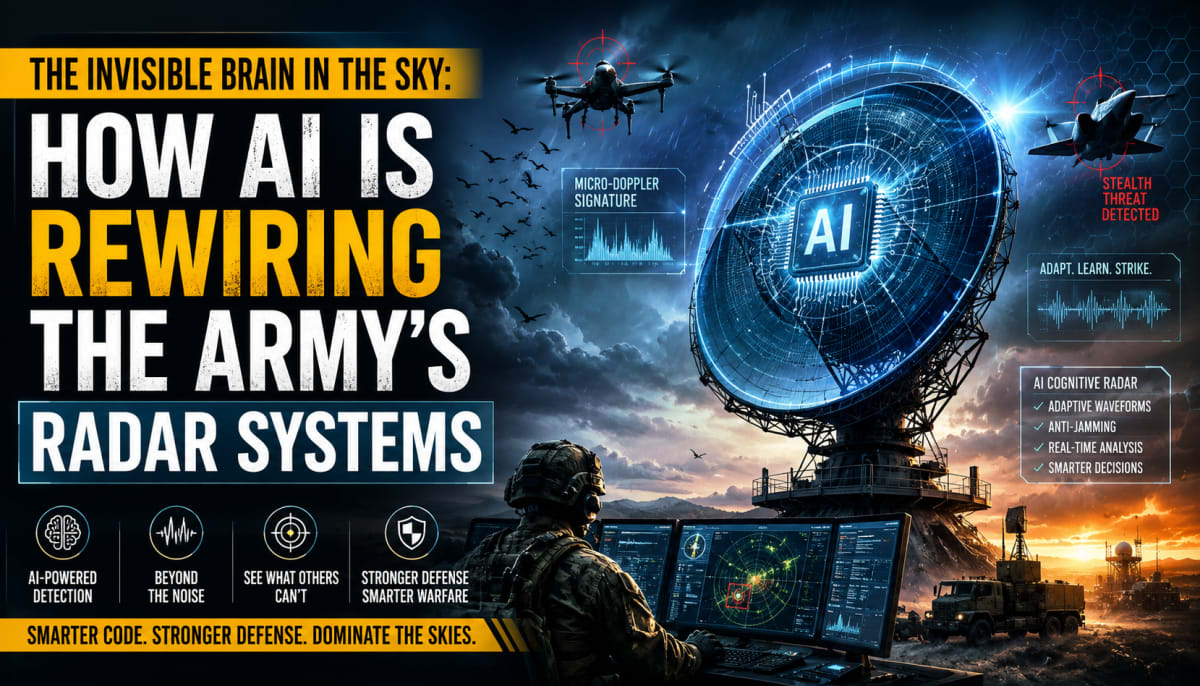
The Invisible Brain in the Sky: How AI is Rewiring the Army's Radar Systems

Picture this: It’s 0200 hours. You are a radar operator in a forward operating base. Your screen is a chaotic blizzard of green and amber blips. Rain is hammering the antenna, flocks of birds are migrating, and the enemy is actively trying to jam your frequencies. Somewhere in that digital snowstorm is a hostile loitering munition, skimming just above the tree line, trying to slip past your defenses.
Legacy radar systems would choke here. They are blinded by "clutter"—the useless echoes bouncing off rain, terrain, and birds. They throw up false alarms until the operator goes blind from fatigue, or worse, they miss the threat entirely.
But today, there is a new player in the electromagnetic spectrum. Artificial Intelligence isn't just a Silicon Valley buzzword in the defense sector; it has literally crawled inside the radar’s signal processor. It has turned a dumb, echoing metal dish into a cognitive, thinking entity. Let’s strip away the marketing jargon and look at the hard, peer-reviewed science of how AI is fundamentally rewriting the rules of radar warfare, and how it’s creating a massive geopolitical equalizer.
The Hard Science: How AI Actually Works Inside the Radar.
To understand the revolution, we have to look at the physics. Traditional radar relies on the time-of-flight and the Doppler shift of a bounced radio wave to calculate range and velocity. It’s basic physics governed by the Radar Range Equation. But physics has a hard limit when the target is a stealth drone or a cruise missile hugging the terrain. The Signal-to-Noise Ratio (SNR) drops into the negative, and the target vanishes into the background.
Enter Deep Learning.
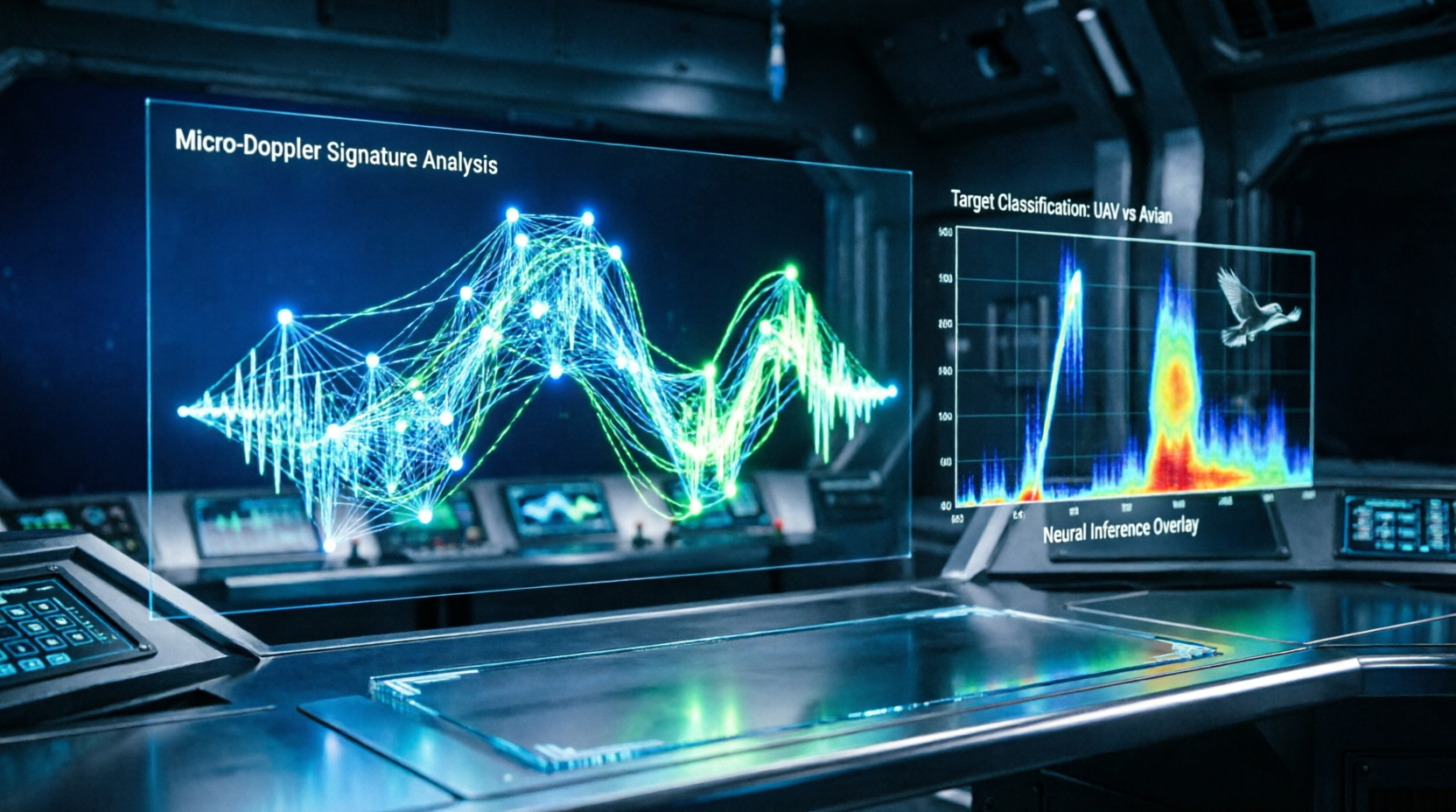
When an object reflects a radar pulse, it doesn't just return a simple echo. It returns a complex, distorted waveform. If a bird is flying, the flapping of its wings creates a very specific, oscillating frequency modulation on the returning wave. This is called the Micro-Doppler signature. A quadcopter drone’s spinning propellers create a completely different micro-Doppler signature. A human crawling creates yet another.
A traditional radar just sees "moving object." An AI-powered radar, utilizing Convolutional Neural Networks (CNNs) and Recurrent Neural Networks (RNNs), analyzes the spectrogram of that returning wave in milliseconds. It reads the microscopic ripples in the frequency. It doesn't just see a blip; it reads the target's biometric fingerprint.
Furthermore, AI is completely revolutionizing Constant False Alarm Rate (CFAR) detection. Traditional radars use Cell-Averaging CFAR to set a detection threshold, which fails miserably in multi-target environments or near heavy clutter. AI replaces this with Deep-Learning CFAR. It continuously learns the real-time electromagnetic environment, applying non-linear filtering to separate the signal from the noise with a level of precision that mimics the human brain tuning out background chatter at a crowded party. It pulls stealth targets out of the negative SNR mud by recognizing the mathematical anomalies in the noise floor.

Supercharging Performance: The Rise of Cognitive Radar.
This brings us to the holy grail of modern defense tech: Cognitive Radar.
In a legacy system, the radar transmits a fixed waveform. If the enemy uses Electronic Warfare (EW) to jam that specific frequency, the radar is blinded. Cognitive radar, powered by Reinforcement Learning, operates in a closed-loop system. It perceives the environment, realizes it is being jammed, and autonomously alters its waveform, pulse repetition frequency (PRF), and beam shape in real-time. It "hops" frequencies faster than the enemy’s jammer can react. It is playing a high-speed game of chess in the electromagnetic spectrum, and it never loses.
Then there is Synthetic Aperture Radar (SAR), used by high-altitude drones and satellites to map the ground. Historically, SAR images were grainy and required heavy computational lifting to resolve. Today, AI-driven Automatic Target Recognition (ATR) algorithms can take raw, noisy SAR data and instantly reconstruct a high-fidelity image. It can differentiate between a deployed ballistic missile launcher and a civilian logging truck, even through thick cloud cover or jungle canopy, in a fraction of a second. It turns raw math into actionable intelligence before the human brain can even process the image.
The Titans: How Global Superpowers are Deploying AI Radar
If you look at the defense budgets of the world’s military heavyweights, they aren't just buying bigger antennas; they are buying smarter algorithms.
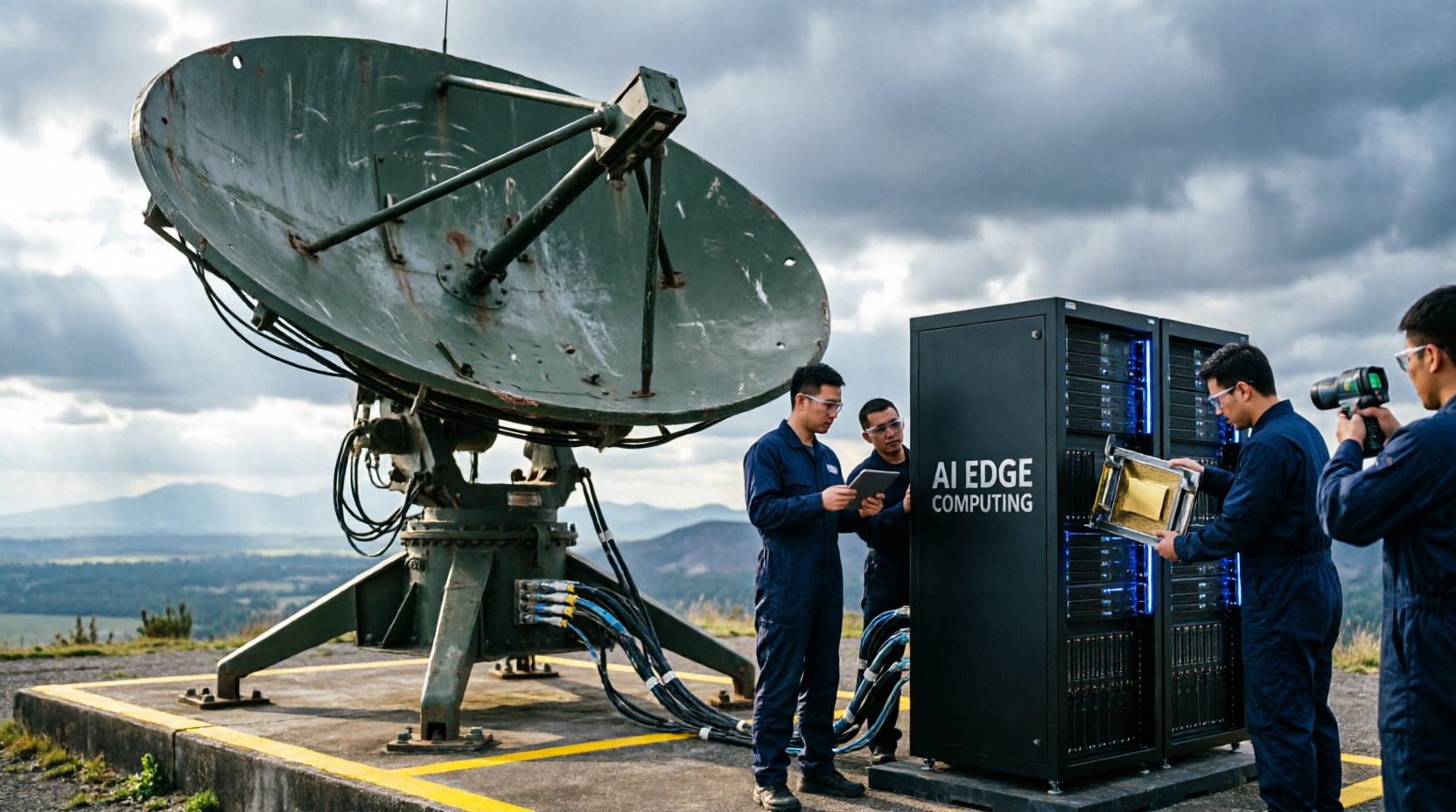
The United States through DARPA and the Pentagon’s Joint All-Domain Command and Control (JADC2) initiative, is pushing "Sensor Fusion." They don't rely on one giant radar. They use AI to fuse data from hundreds of micro-sensors—satellites, AWACS, ground radars, and even soldier-worn devices. The AI creates a single, unified "God’s-eye" track. If an enemy stealth fighter slips past one sensor's field of view, the AI predicts its trajectory and cues another sensor to look exactly where the jet will be in three seconds.
China is heavily investing in AI to counter stealth technology. Their research institutes are publishing papers on using AI to detect the minute, non-linear distortions that stealth coatings cause in radar returns. They are also pioneering "Quantum Radar" concepts, where AI is used to filter out the incredibly faint quantum entanglement signals from the massive background noise of the atmosphere, theoretically making stealth completely obsolete.
Israel has practically gamified air defense with AI. In systems like the Iron Dome, the radar doesn't just track an incoming rocket; the AI instantly calculates its parabolic trajectory. If the math shows the rocket will land in an open field, the radar ignores it. If it’s heading for a populated area, the AI instantly fires an interceptor. This saves millions of dollars in interceptor missiles and guarantees 100% focus on actual threats.
The Great Equalizer: How Developing Nations Can Weaponize Legacy Radars with AI.
Now, here is the most fascinating geopolitical angle. What about the developing nations? The countries that cannot afford to spend $2 billion on the latest AESA (Active Electronically Scanned Array) radar systems. They are stuck with 1980s and 90s legacy hardware. Are they sitting ducks?
Absolutely not. This is where AI becomes the ultimate asymmetric weapon. You don't need to replace the hardware; you just need to upgrade the brain.
1. Software-Defined Radar (SDR) and Edge Computing.
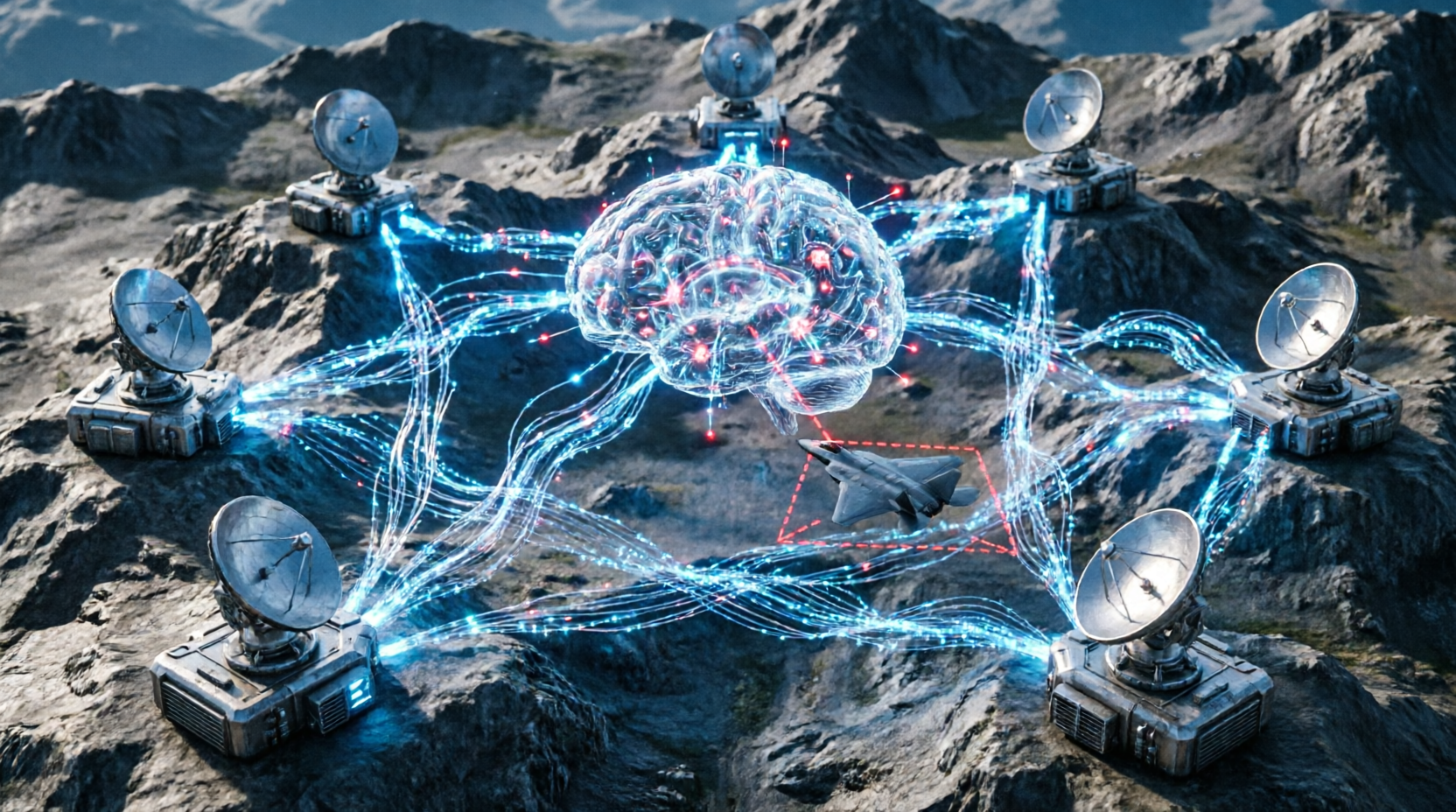
A developing nation can keep their old, heavy, mechanically scanning radar dish. But they can rip out the old analog processing units and install an "Edge AI" server right at the base of the antenna. This localized AI processes the raw,analog radio frequency (RF) data before it even hits the main display. By applying advanced machine learning noise-reduction algorithms to the raw signal, they can effectively squeeze a 30% to 40% increase in detection range and accuracy out of a 30-year-old machine. They are bypassing the physical limits of their old transmitters by simply processing the returning echoes better.
2. Synthetic Data Training via GANs.
The biggest hurdle for a weaker nation is that they don't have access to enemy stealth jets to train their AI. How do you teach an AI to recognize an F-35 if you’ve never seen one on your radar? The answer is Generative Adversarial Networks (GANs). Defense scientists can use physics-based electromagnetic simulations to generate millions of "synthetic" radar echoes of stealth aircraft. The AI trains on this synthetic data, learning the theoretical micro-flaws in stealth coatings. When the real thing finally enters their airspace, the AI recognizes the theoretical fingerprint it studied in the simulator.
3. Multi-Static Distributed Radar Networks.
Stealth aircraft are designed to deflect monostatic radar waves (where the transmitter and receiver are in the same place) away from the source. But if a country takes five of their old, cheap radars and spreads them 50 miles apart, networking them together, the geometry changes. The stealth jet might deflect the signal away from Radar A, but that same signal bounces right into Radar B. This is called the Bistatic Radar Cross-Section (BRCS). AI acts as the central brain, fusing these fragmented, weak, off-angle echoes from multiple cheap radars to triangulate and track the stealth target. It turns a bunch of obsolete junk into a highly lethal, distributed kill web.
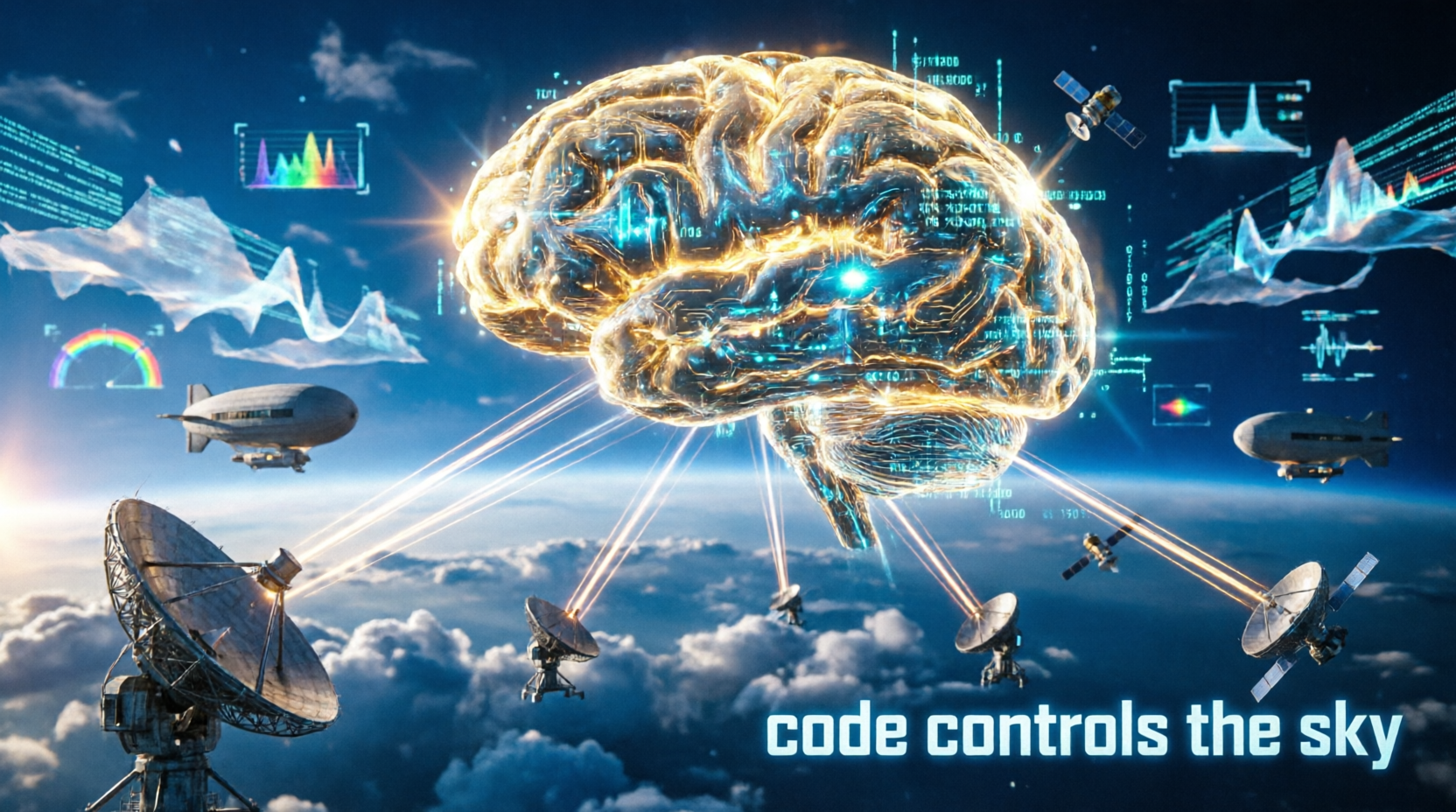
The Verdict: The Sky Belongs to the Smartest Code.
The paradigm of aerial warfare has permanently shifted. The sky no longer belongs to the nation with the biggest dishes or the deepest pockets. It belongs to the nation with the smartest code.
AI has transformed the radar from a passive observer into a predatory, thinking hunter. It has taken the rigid laws of physics and bent them using the fluid power of machine learning. Whether it’s a superpower fusing space-based sensors to track hypersonic glide vehicles, or a developing nation breathing new, lethal life into Cold War-era hardware using Edge AI and synthetic data, the message to every defense scientist and military strategist is clear.
In the modern electromagnetic battlefield, the hardware is just the muscle. The algorithm is the soul. And he who controls the algorithm, controls the sky.
Comments (0)
Please sign in to join the conversation.
No comments yet. Be the first to join the discussion!