
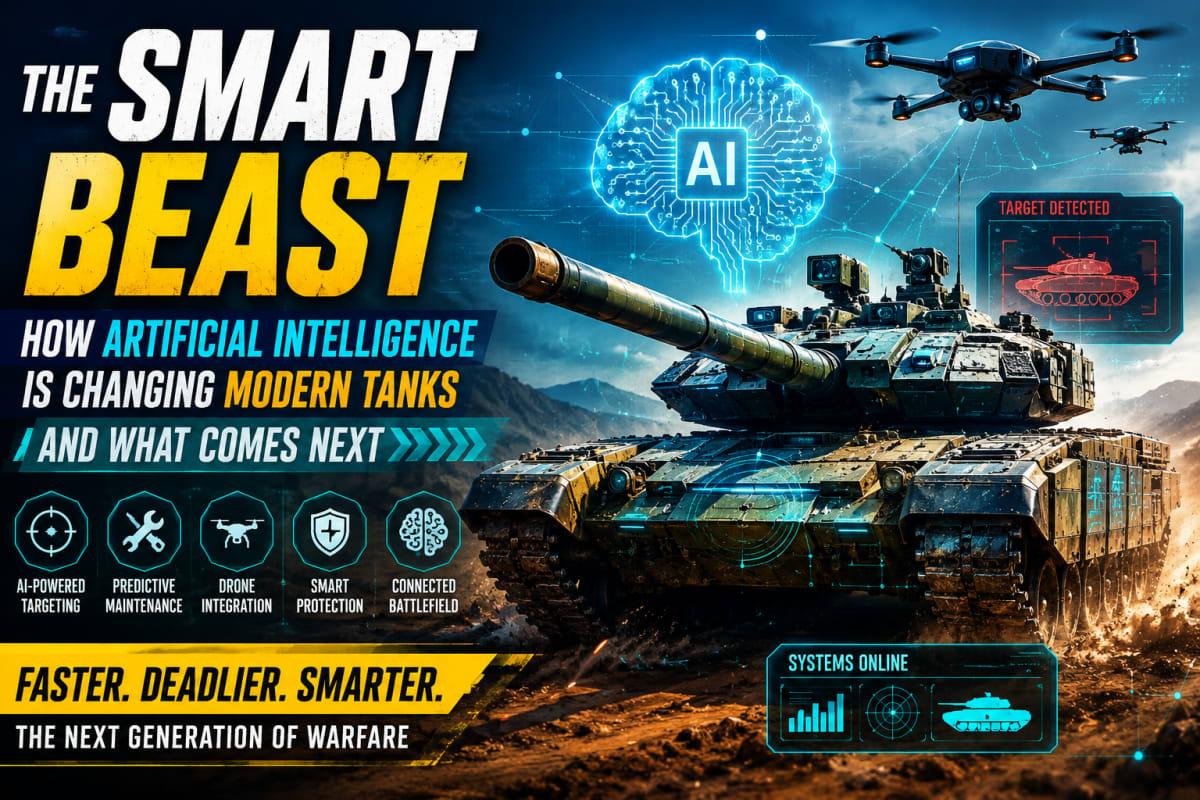
The Smart Beast: How Artificial Intelligence is Changing Modern Tanks and What Comes Next.
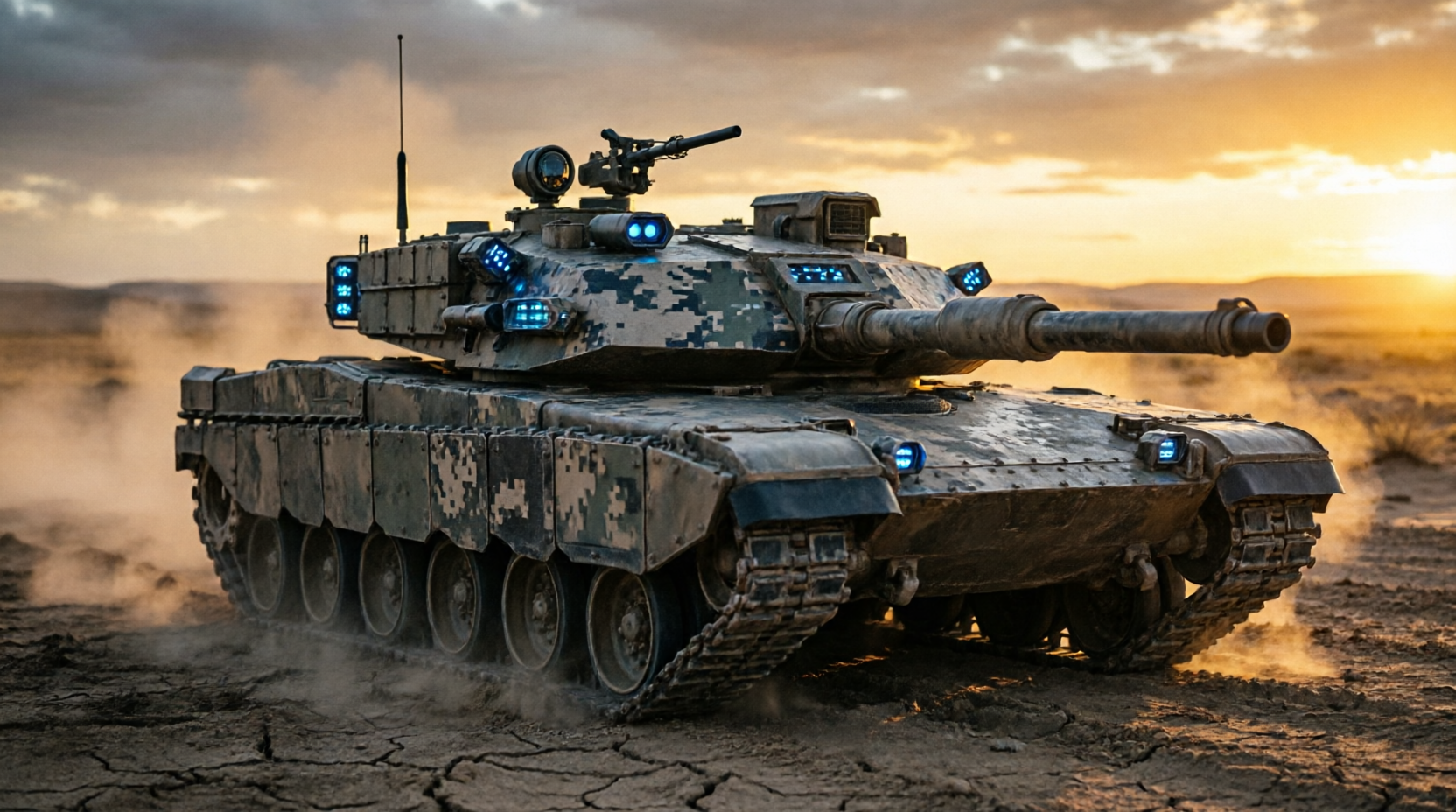
When you picture a tank, you probably imagine a massive, loud, steel beast crushing through mud and firing a giant gun. For a long time, that is exactly what they were. A tank was just a thick metal box with a big cannon, driven by human muscle and aimed by human eyes. But today, the battlefield has changed, and the tank has changed with it.
Modern tanks are no longer just heavy metal. They are rolling computers. At the heart of this change is Artificial Intelligence, or AI. But do not worry, this is not about robots taking over the battlefield. AI in a tank is simply a tool. It is a smart assistant that helps the human crew see further, shoot straighter, and stay alive longer.
Let us first look at how AI is already being used in modern tanks to find and destroy targets, and then we will explore practical solutions for how we can make these machines even better in the future.
How AI is Used in Tanks Today.
1. Finding the Enemy in the Mess.
In a real war, the battlefield is chaotic. There is smoke, dust, bad weather, and the enemy is hiding behind trees or using fake decoys. In the past, a gunner had to squint through a small screen and guess if a blurry shape was an enemy tank or just a rock.
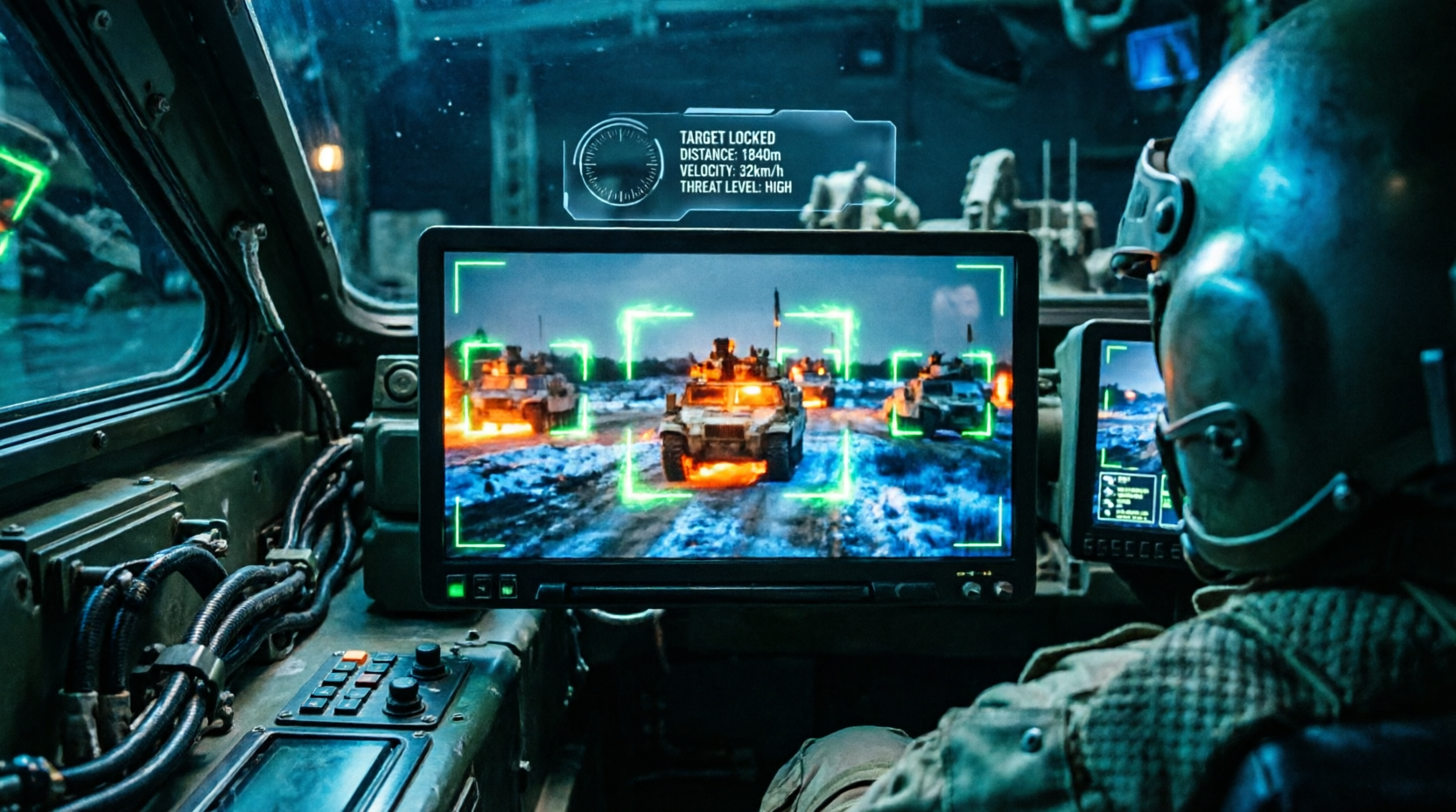
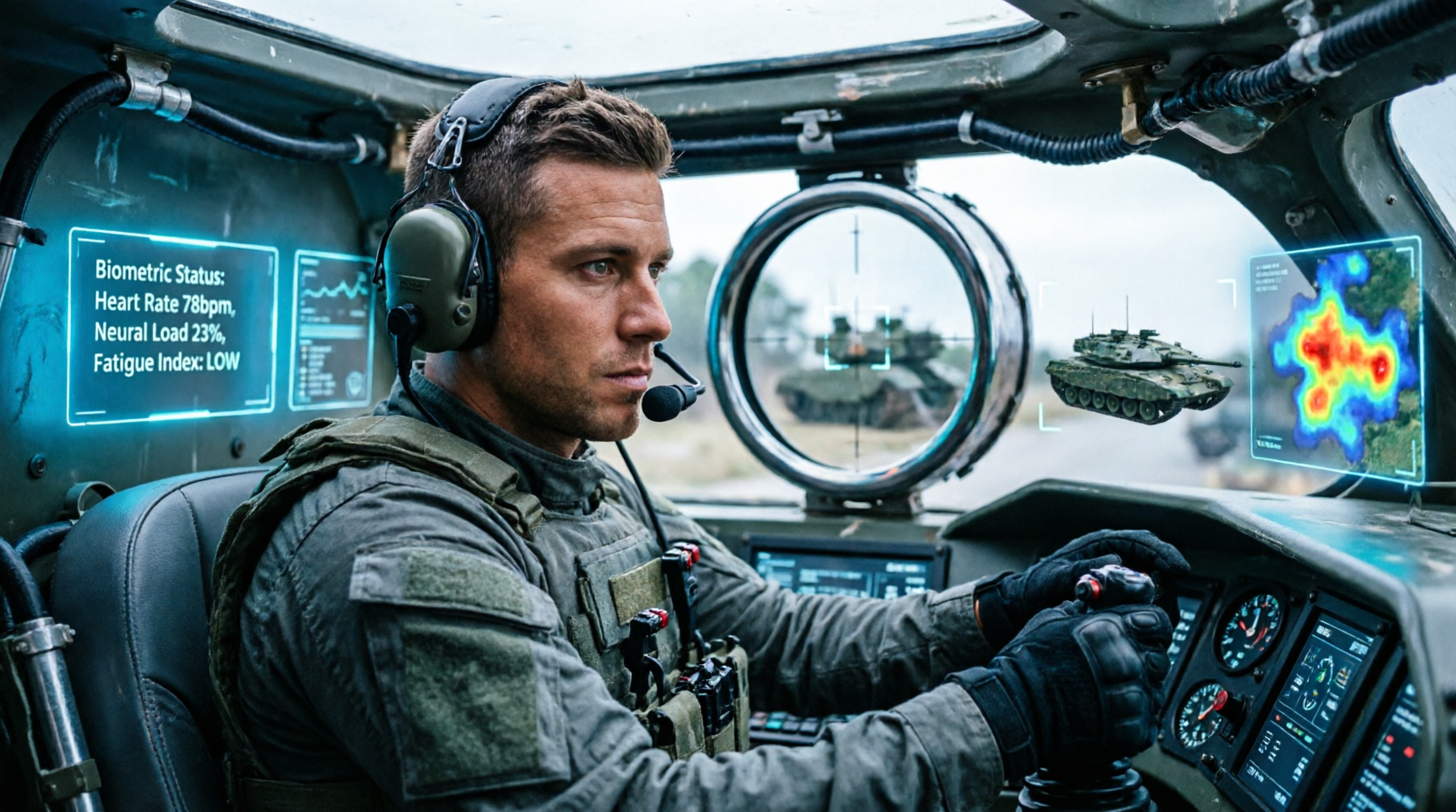
Today, tanks use AI-powered computer vision. The tank’s cameras and thermal sensors feed video into a computer. The AI has been trained on millions of pictures of military vehicles. When the gunner looks through the screen, the AI draws a bright box around the enemy tank. It can even tell the difference between a real tank and a wooden fake. It highlights the exact weak spot on the enemy tank where a shell will do the most damage. This takes the guesswork out of finding the target.
2. Hitting a Moving Target.
Firing a tank gun is actually a very hard math problem. The tank is moving. The target is moving. The wind is blowing. The earth is rotating. The gunner has to calculate all of this in a few seconds to hit the target.
Modern tanks use AI to solve this math instantly. When the gunner locks onto a target, the AI takes over the fine adjustments. It calculates the speed of the enemy, the wind speed, and the distance, and it automatically moves the heavy gun barrel to the perfect angle. By the time the gunner presses the fire button, the gun is already perfectly aimed. This means the first shot hits the target, which is the most important rule of tank warfare.
3. Hearing the Invisible Threats.
Sometimes, the enemy shoots at you before you see them. Modern tanks are fitted with acoustic sensors. AI listens to the sound of the battlefield. If a sniper fires a bullet or an anti-tank missile is launched, the AI hears the specific sound wave. In a fraction of a second, it calculates exactly where the shot came from and flashes a warning on the crew’s screens, showing the direction of the threat. This gives the crew precious seconds to react and hide.
Future Solutions: How to Make Tanks Even Smarter.
While current AI is great, technology moves fast. If we want to build the next generation of tanks, we need to look at new ways AI can solve old problems. Here are some practical, solution-based ideas to improve tank performance using AI.
Solution 1:
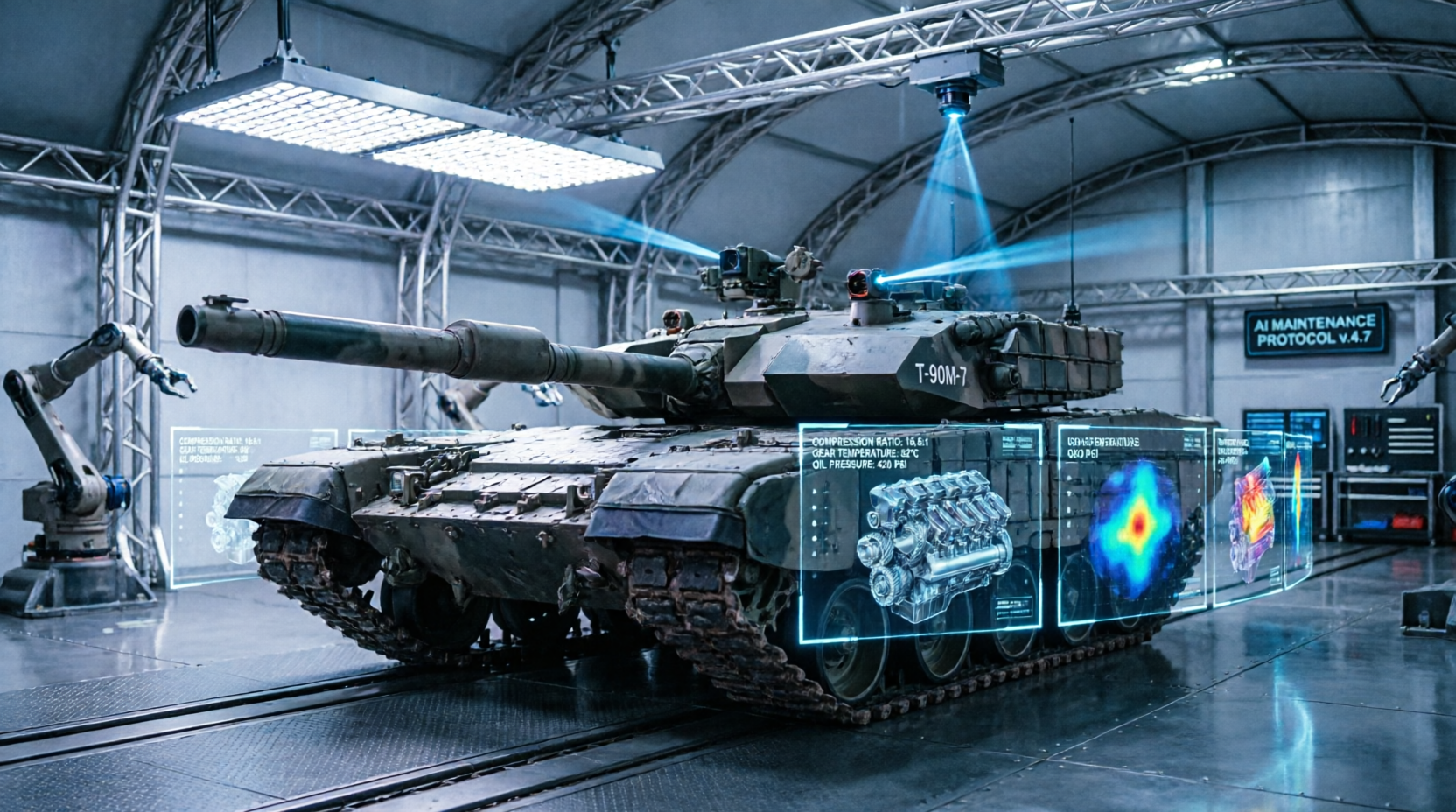
Predictive Maintenance (The Tank That Warns You Before It Breaks)**
One of the biggest problems in the army is broken vehicles. A tank is made of thousands of moving parts. Usually, a part breaks during a battle, and the tank is out of action.
We can use AI to fix this before it happens. By putting small vibration and heat sensors on the engine, the tracks, and the gun mechanism, the AI can "listen" to the tank. If a gear starts to wear out, it makes a tiny, different vibration. The AI notices this change and tells the mechanics, "Replace gear number four this weekend, or it will break in three days." This is called predictive maintenance. It ensures that when the army rolls out, every single tank is ready to fight, saving millions of dollars and countless lives.
Solution 2:
The Tank as a Drone Commander.
A tank has a major weakness: it cannot see over a tall hill or behind a large building. If a tank drives over a hill, it might drive straight into an ambush.
The solution is to connect the tank’s AI to a swarm of small drones. Before the tank moves over a hill, it launches a small, quiet drone. The drone flies up, looks over the hill, and sends the video back to the tank. The tank’s AI instantly scans the drone’s video, finds any hidden enemy tanks, and calculates the firing solution. The main tank can then fire its gun over the hill at the enemy, all while staying completely hidden behind the dirt. The tank becomes a mobile command center, fighting safely from a distance.
Solution 3:
Smart Driving and Auto-Evasion
Driving a 60-ton tank through deep mud, snow, or ruined city streets is exhausting. A tired driver makes mistakes. Furthermore, if an anti-tank missile is fired at the tank, the driver has to react fast to dodge it.
We can give the tank an AI auto-pilot for rough terrain. The AI can control the tracks to keep the tank perfectly balanced, ensuring the main gun stays completely steady even when driving over big rocks. More importantly, we can add an "auto-evasion" feature. If the tank’s sensors detect an incoming missile, the AI can instantly take control of the steering and drive the tank behind a nearby wall or large tree in a split second, much faster than a human driver could react.
Solution 4:
Upgrading the Shield (Smarter Active Protection).
Many modern tanks have an Active Protection System (APS). This is like a shield that shoots down incoming rockets before they hit the tank. But what happens if the enemy fires three rockets at the same time from different directions? The system might get confused or run out of interceptors.
AI can make this shield much smarter. The AI can instantly calculate the flight path of all three rockets. It figures out which one will hit the tank first, shoots it down, and then immediately aims at the second one. It can also predict where the rocket will hit the tank and turn the strongest part of the tank's armor toward the impact. By making the APS think faster, we make the tank almost invincible to standard anti-tank weapons.
Solution 5:
Managing Crew Fatigue and Stress
The most important part of any tank is not the gun or the engine; it is the human crew inside. In a battle, soldiers get very tired, stressed, and their eyes get heavy. A tired gunner might miss a target or fail to see an enemy sneaking up.
We can use AI to protect the crew’s mental state. Small cameras inside the tank can watch the gunner’s eyes and face. If the AI notices the gunner is losing focus, blinking too slowly, or showing signs of high stress, it can gently alert them. In extreme cases, if the gunner is too tired to track a fast-moving enemy, the AI can temporarily take over the tracking, keeping the crosshairs on the target until the gunner is ready to fire. The AI acts as a co-pilot who never sleeps, ensuring the human crew is always at their best.
Solution 6:
Sharing the Battlefield Brain.
Right now, if one tank sees an enemy, the commander has to use a radio to tell the other tanks. This takes time.
The future solution is an AI network that connects all the tanks in a unit. If Tank A spots an enemy, its AI instantly shares the exact location, speed, and type of enemy with Tanks B, C, and D. The AI in the other tanks automatically updates their maps and suggests the best firing positions. The whole group of tanks starts acting like a single, giant brain. They can surround and defeat the enemy before the enemy even knows they are being attacked.
Conclusion.
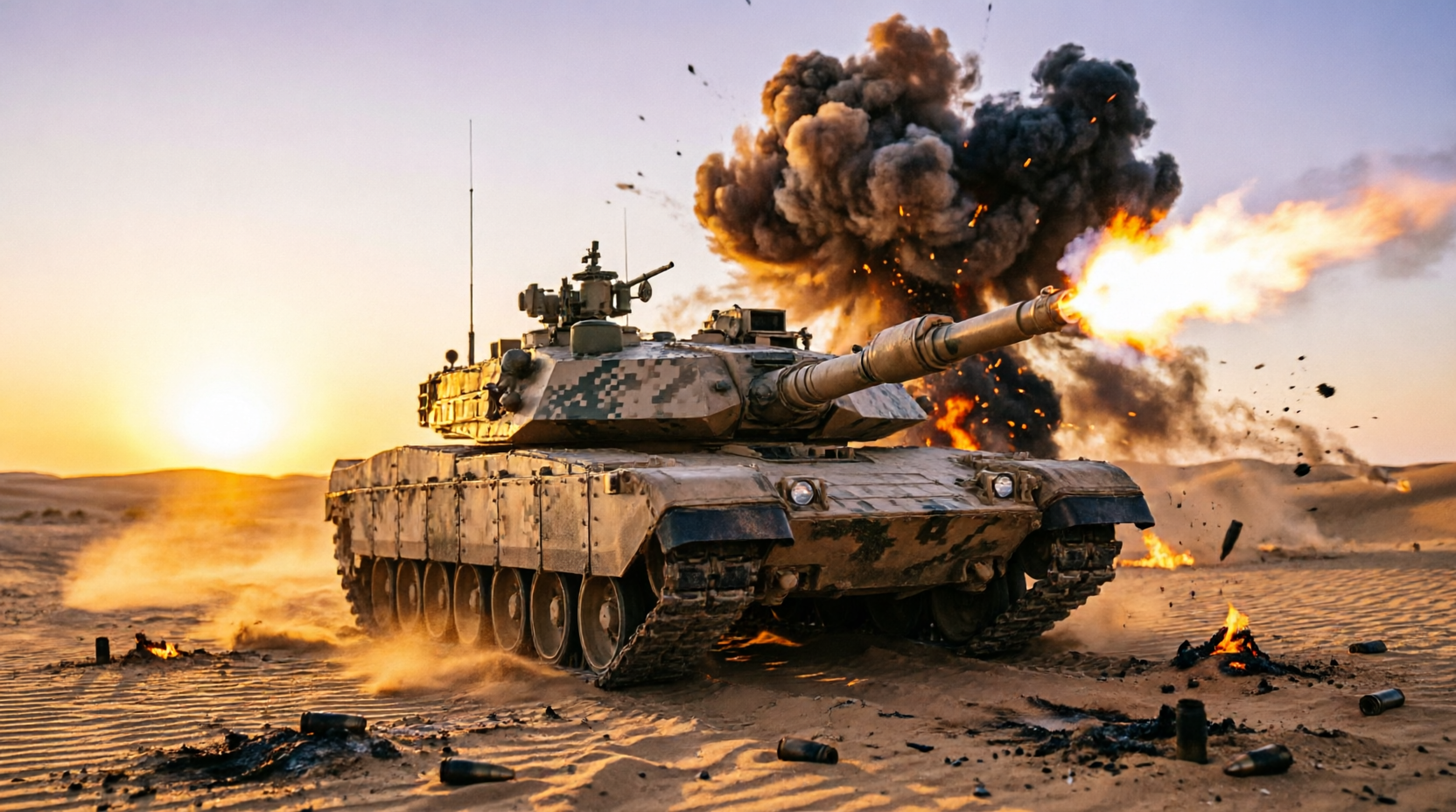
Artificial Intelligence is not changing the basic job of a tank. The tank is still there to break through enemy lines, support the infantry, and destroy heavy targets. What AI does is remove the limits of human physics and human fatigue.
By using AI for better targeting, smart maintenance, drone coordination, and crew protection, we can build a tank that is faster, deadlier, and much harder to destroy. The goal of AI in the military is never to replace the soldier. The goal is to give the soldier a massive advantage, ensuring they can complete their mission and, most importantly, come home safely. The tanks of the future will still be heavy beasts of steel, but thanks to AI, they will be the smartest beasts on the battlefield.
Comments (0)
Please sign in to join the conversation.
No comments yet. Be the first to join the discussion!