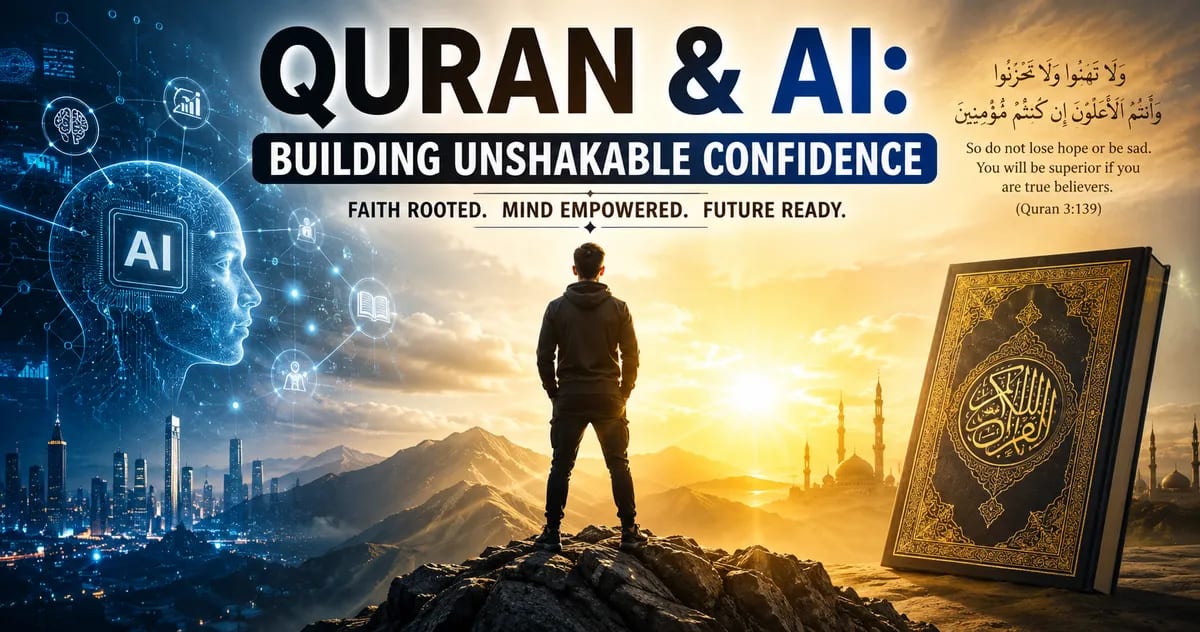
Quran and AI: Building Unshakable Confidence
My hands would not stop shaking. I was standing outside the door of a room where twelve people were waiting to hear me present something I had worked on for three months, and my mind had gone completely blank. Not nervous the normal way. Blank. My throat felt tight, like the words physically could not come out even if I forced them.
I remember pressing my back against the wall in that hallway and thinking, this is it, I am going to walk in there and say nothing worth hearing. And then, almost without deciding to, I whispered something I had memorized years ago without ever really understanding why. My Lord, open my chest for me. Ease my task for me. Untie the knot from my tongue.
I did not feel a lightning bolt of courage. What I felt was smaller and stranger than that. My shoulders dropped an inch. My breathing slowed by maybe half a second. And somehow that was enough to walk through the door.
That sentence was not something I made up in a moment of desperation. It is the exact dua Prophet Musa, peace be upon him, made when Allah told him to go stand in front of Pharaoh and speak. If the man who parted the sea once needed to ask for courage before opening his mouth, then you and I are allowed to need the same thing.
This article exists for anyone who has ever frozen at the door of a hard moment. We are going to look honestly at where fragile confidence comes from, walk through what the Quran specifically says about courage and self worth, and then build a real, practical plan, using both timeless faith and modern AI tools, to help you carry that confidence into your own hard moments.
Where Fragile Confidence Actually Comes From
Most of us were quietly trained to build our confidence on the wrong material. We measure ourselves against grades, job titles, follower counts, and the passing approval of people who forget us the moment they scroll past. Psychologists have a name for this, contingent self worth, meaning your value rises and falls with things you cannot fully control.
That kind of confidence is exhausting to maintain. One rejection, one awkward silence after you speak up, one person who does not text back, and the whole structure wobbles. You start avoiding rooms instead of walking into them. You rehearse conversations in your head that you never end up having.
There is a sturdier foundation available, and it does not ask you to pretend you have no fear. It asks you to bring your fear honestly to Allah and ask for help carrying it.
What the Quran Specifically Says About Courage
قَالَ رَبِّ اشْرَحْ لِي صَدْرِي
وَيَسِّرْ لِي أَمْرِي
وَاحْلُلْ عُقْدَةً مِّن لِّسَانِي
يَفْقَهُوا قَوْلِي
اس نے کہا اے میرے رب میرا سینہ کھول دے اور میرے کام کو آسان کر دے اور میری زبان کی گرہ کھول دے تاکہ لوگ میری بات سمجھ سکیں
He said, My Lord, expand for me my chest, and ease for me my task, and untie the knot from my tongue, so that they may understand my speech
This is from Surah Ta Ha, verses 25 to 28, and it is not a poetic metaphor. It is a real prayer said by a real prophet who was terrified of the exact same thing many of us are terrified of, opening our mouths in front of people who intimidate us. Musa did not pretend to be fearless. He asked Allah to make him capable despite the fear, and that request was accepted and recorded permanently in the Quran so that every person after him would have the same words available.
الَّذِينَ قَالَ لَهُمُ النَّاسُ إِنَّ النَّاسَ قَدْ جَمَعُوا لَكُمْ فَاخْشَوْهُمْ فَزَادَهُمْ إِيمَانًا وَقَالُوا حَسْبُنَا اللَّهُ وَنِعْمَ الْوَكِيلُ
وہ لوگ جن سے کہا گیا کہ لوگ تمہارے خلاف جمع ہو چکے ہیں ان سے ڈرو تو اس بات نے ان کے ایمان میں اضافہ کر دیا اور انہوں نے کہا ہمارے لیے اللہ کافی ہے اور وہ بہترین کارساز ہے
Those who were warned, the people have gathered against you so fear them, it only increased them in faith, and they said, Allah is sufficient for us, and He is the best Disposer of affairs
Found in Surah Aal e Imran, verse 173, this verse was revealed after the believers faced a real, credible threat following the Battle of Uhud. Notice what happened to their confidence when they were told to be afraid. It did not shrink. It grew, because they placed the size of the threat next to the size of Allah and answered accordingly. That single sentence, Allah is sufficient for us, has calmed frightened hearts for over a thousand years.
وَلَا تَهِنُوا وَلَا تَحْزَنُوا وَأَنتُمُ الْأَعْلَوْنَ إِن كُنتُم مُّؤْمِنِينَ
اور بودے نہ بنو اور نہ غمگین ہو، اگر تم واقعی مومن ہو تو تم ہی غالب رہو گے
So do not weaken and do not grieve, for you will be superior if you are true believers
This is from Surah Aal e Imran, verse 139, spoken to believers after a genuinely difficult battle, not in a moment of victory. Confidence rooted in sincere faith is available precisely in the moments when it seems least justified by circumstances.
فَإِنَّ مَعَ الْعُسْرِ يُسْرًا
إِنَّ مَعَ الْعُسْرِ يُسْرًا
پس بے شک تنگی کے ساتھ آسانی ہے، بے شک تنگی کے ساتھ آسانی ہے
So surely with hardship comes ease, indeed with hardship comes ease
From Surah Ash Sharh, verses 5 and 6, said twice in a row on purpose. Whatever tight, breathless moment you are in right now, this verse insists that ease is already attached to it, not waiting somewhere far away.

This search for courage in the face of fear is not unique to one faith. In the Bible, Joshua 1:9 tells believers to be strong and courageous and not to be afraid, because God is with them wherever they go, a promise many Christians hold onto before hard moments. In the Hebrew Bible, Psalm 27:1 asks who there is to fear when the Lord is one's light and salvation, a verse still recited by Jews today for strength in difficult times. In the Bhagavad Gita, chapter 2 verse 3, Krishna tells Arjuna to cast off weakness of heart and rise, urging him not to give in to a moment of fear right before a difficult duty. In Buddhist teaching, the Dhammapada reminds us that a person is truly their own protector, and that mastering oneself is the hardest and most valuable kind of victory. Different traditions, in their own words, keep arriving at the same quiet truth, that courage grows when a person turns toward something greater than their fear.
Turning These Verses Into a Daily Practice
Real confidence looks less like a personality trait and more like a habit you rehearse. Before a hard conversation, you say the dua Musa said, not because it is a magic formula, but because it puts words to exactly what you are afraid of and hands that fear to Allah honestly. When you are facing something that feels bigger than you, you say Hasbunallahu wa ni mal wakeel and notice, like the early believers did, that faith can grow instead of shrink under pressure. When you fail at something, you remember that ease was promised alongside hardship, not instead of it, meaning the discomfort you feel right now is not separate from your growth, it is part of the same sentence.
Where AI Genuinely Supports This Work
AI cannot pray for you, and it should never be treated as a source of spiritual authority. What it can do well is help you build the daily structure that turns a verse you read once into a habit you actually live by.
Use AI to turn Musa's dua into a personalized reminder that pops up right before events that make you nervous, a meeting, an exam, a difficult phone call. Ask AI to explain the story of the Battle of Uhud in plain language so verse 173 stops being an abstract quote and becomes a story you understand. Have AI help you draft a short journal entry template so you can track which moments of fear you faced this week and how you handled them. Ask it to break an intimidating task into small enough pieces that starting does not feel like leaping off a ledge. Let it track your habits so that thirty days from now you have actual evidence of growth instead of a vague feeling.
Remember plainly, AI is a scheduling and organizing assistant here, nothing more. The actual courage still comes from you and from Allah, not from a chatbot.

Seven Day Quran Action Plan
Day 1
Read Surah Ta Ha, verses 25 to 28, slowly, and picture Musa saying them before facing Pharaoh. Reflect on one specific moment this week where you feel that same knot in your throat. Takeaway, asking for courage is not weakness, it is exactly what a prophet did.
Day 2
Recite the same dua before something that makes you nervous today, even something small like a phone call you have been avoiding. Reflect afterward on whether your chest actually felt lighter. Takeaway, the request for ease is meant to be used, not just admired.
Day 3
Read the story behind verse 3:173 and the Battle of Uhud in a translation with commentary. Reflect on a threat or fear in your life that currently feels larger than your faith. Takeaway, faith is allowed to grow under pressure instead of breaking.
Day 4
Say Hasbunallahu wa ni mal wakeel out loud once today, in a private moment. Reflect on what specifically you are handing over when you say it. Takeaway, sufficiency does not mean the problem disappears, it means you are not facing it alone.
Day 5
Read verse 3:139 and think of a recent setback you have not fully let go of. Reflect on the difference between grieving something and being defined by it. Takeaway, weakness is a passing state, not a permanent identity.
Day 6
Read Surah Ash Sharh, verses 5 and 6, twice, exactly as they are written. Reflect on one current hardship and try to name what ease might look like inside it, not after it. Takeaway, ease was never promised as a replacement for hardship, it was promised alongside it.
Day 7
Sit with all four verses together, in the order you read them this week. Reflect on which one you needed most and why. Takeaway, courage in the Quran always sounds specific and honest, never like empty positivity.

Seven Day AI Action Plan
Day 1
Ask your AI assistant to set a daily reminder that shows Musa's dua right before your most anxiety inducing task each day. Goal, use it at least once today before something real. Reflect on what changed in your body, even slightly.
Day 2
Ask AI to explain the Battle of Uhud and verse 3:173 in five simple sentences. Goal, be able to explain the story back in your own words. Reflect on how understanding the history changes how the verse feels.
Day 3
Ask AI to help you build a short daily journal template with three questions about fear, action, and outcome. Goal, fill it out honestly tonight. Reflect on any pattern in what you are actually afraid of.
Day 4
Ask AI to break one task you have been avoiding into five small steps. Goal, complete only the very first step today. Reflect on how much smaller the task feels now.
Day 5
Ask AI to quiz you gently on the meaning of verse 3:139. Goal, answer three questions correctly without checking notes. Reflect on what part of the verse surprised you.
Day 6
Ask AI to set up a simple thirty day tracker for practicing one specific courageous habit, like speaking up once daily. Goal, log day one honestly. Reflect on why this particular habit matters to you right now.
Day 7
Ask AI to summarize everything you journaled this week into three sentences. Goal, identify one clear next step from that summary. Reflect on how far this week actually moved you, even if it does not feel dramatic.
A Practical Checklist You Can Actually Use
Recite Musa's dua before something specific that scares you, not just in general
Learn the story behind at least one verse instead of only memorizing its words
Journal honestly about fear, action, and outcome, with or without AI prompts
Use AI strictly for structure and reminders, never for spiritual decisions
Track one courageous habit for thirty days so growth becomes visible
Talk to a professional if fear ever tips into something heavier than everyday nerves
Frequently Asked Questions.
Can I really recite Musa's dua for something as small as a work presentation
Yes. The dua was given for a moment of speaking under pressure, and speaking under pressure is exactly what a presentation, interview, or difficult conversation involves.
Is it appropriate to let AI remind me to recite verses or duas
Yes, as long as AI is simply organizing your existing spiritual practice, not replacing your understanding, sincerity, or consultation with knowledgeable scholars.
What if reciting these verses does not make my anxiety disappear completely
That is expected and normal. These verses are not designed to erase fear instantly, they are designed to give you steadiness while you walk through the fear, which is a very different and more honest kind of help.
A Closing Thought.
Confidence was never meant to feel like the complete absence of fear. Musa was still afraid when he asked Allah to open his chest, and Allah answered him anyway, in the middle of the fear, not after it had disappeared. Whatever door you are standing outside of right now, whatever room feels too big for you to walk into, you are allowed to ask for the same thing he asked for. Say the words honestly, build the small daily habits that make them real, and let both faith and the practical tools available to you carry you the rest of the way in.
Suggested Internal Links.
The Story of Musa and Pharaoh Explained Simply
How to Build a Daily Dua Habit
Using AI for Islamic Learning Without Losing Sincerity
Suggested External Authoritative Sources
Quran.com for verified verse translations and tafsir
IslamQA for scholarly explanations of these verses
American Psychological Association for research on fear and confidence.