
Using Hypnosis to Manage Panic Attacks: A 7-Day Mind Training Program
There is a woman named Amelia who used to feel her heart racing every time she stepped into a crowded train. Her hands would go cold, her chest would tighten, and a voice inside her head would whisper, "You are going to die right here." She did not know that what she was feeling had a name — a panic attack. And she did not know that the same mind that was creating this fear could also be trained to switch it off. This is where hypnosis enters the story.

What Hypnosis Really Is.
Many people think hypnosis is a magic trick, something you see on a stage where a person clucks like a chicken. Real hypnosis is nothing like that. It is simply a state of deep, focused relaxation where the busy, chattering part of your mind quiets down, and your subconscious mind becomes more open to calm, healthy suggestions. You are not asleep. You are not unconscious. You are actually more aware, but in a soft, slow-motion way — the same feeling you get right before you fall asleep at night, or the feeling you get when you are so absorbed in a good book that you forget the world around you.
The Real Link Between Hypnosis and Panic Attacks.
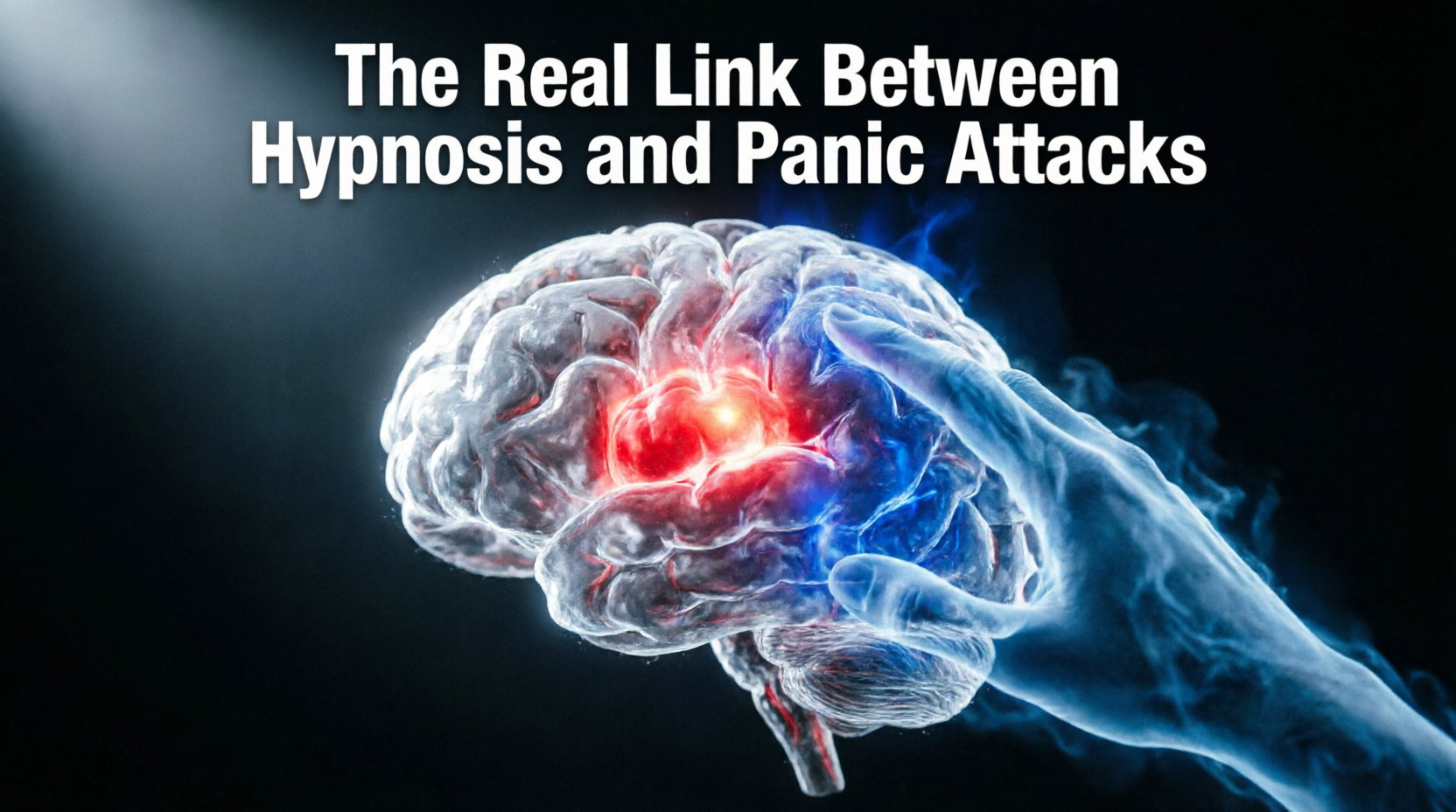
A panic attack is not really about the train, the elevator, or the crowd. It is about the brain's alarm system going off when there is no real danger. Your body reacts as if a tiger is chasing you, even though you are only sitting in traffic. This alarm system lives in a small part of the brain called the amygdala. It cannot tell the difference between a real threat and an imagined one.
Hypnosis works because it speaks directly to this deeper, older part of the mind. When you are in a relaxed hypnotic state, your body naturally slows its breathing, lowers its heart rate, and releases the tension sitting in your muscles. Over time, with regular practice, the mind starts to learn a new pattern — instead of jumping to alarm, it learns to pause, breathe, and stay steady. This is exactly what leading hypnotherapists such as Milton Erickson and later researchers in clinical hypnosis have shown in their work — the subconscious mind can be gently retrained, the same way a river can be redirected if you dig a new path for it early enough.

Why Words and Imagination Matter So Much.
Our subconscious mind does not fully understand the difference between something we vividly imagine and something that is truly happening. This is why, when you imagine a lemon and imagine biting into it, your mouth actually starts to water. The same rule applies to fear. If your imagination has been trained, without you even noticing, to picture disaster, your body will react to that picture as if it were real. Hypnosis simply flips this switch. Instead of imagining fear, you begin imagining safety, calm, and control, and slowly, your nervous system starts believing it.
The 7-Day Mind Training Program.
This program is simple. It does not need any special equipment, and you do not need a therapist standing beside you. All you need is fifteen to twenty quiet minutes a day, and a genuine wish to feel calmer.
Day 1 – Learning to Breathe Like an Anchor.
Sit somewhere quiet. Close your eyes. Breathe in slowly for four counts, hold for four counts, and release for six counts. Do this ten times. This breathing pattern alone tells your nervous system, "We are safe." Today's only goal is to notice how your body feels lighter after ten rounds.
Day 2 – The Body Scan.
Today, add a body scan to your breathing. Starting from your toes, slowly move your attention upward — feet, legs, stomach, chest, shoulders, neck, face. At each point, silently say, "This part of my body is soft and safe now." This step trains your mind to release the small pockets of tension that build up quietly, long before a panic attack ever begins.
Day 3 – Your Safe Place.
Now we introduce visualization, the heart of self-hypnosis. Picture a place where you have always felt completely calm — perhaps a beach, a quiet garden, or your grandmother's kitchen. Make it detailed. What do you hear? What do you smell? Spend ten minutes living inside this place in your imagination. This safe place becomes your mental home base, a place you can return to instantly during a real moment of anxiety.
Day 4 – The Anchor Word.
Choose one simple word — it could be "steady," "calm," or even just "home." While you are deeply relaxed in your safe place from Day 3, repeat this word slowly ten times, allowing it to feel connected to the calm feeling in your body. With practice, this single word becomes a switch. When panic starts rising later in real life, saying this word to yourself will begin pulling your body back toward calm.
Day 5 – Facing the Trigger, Gently.
Today, in your relaxed state, gently picture the situation that usually triggers your panic — the train, the meeting, the crowd. But this time, picture yourself moving through it slowly, breathing steadily, using your anchor word, and staying calm. Do not force this. If it feels too intense, step back to your safe place first, then try again softly. This is how real change happens — a little bit at a time, never by force.
Day 6 – Speaking to Your Subconscious.
While deeply relaxed, speak gently to yourself, almost like a caring friend would. Say things such as, "My body knows how to be calm. I am safe right now. I trust myself." These are not empty words. Said while the mind is relaxed and open, they slowly become new beliefs, replacing the old fearful ones that built up over the years.
Day 7 – Bringing It All Together.
On the final day, combine everything. Breathe using the Day 1 pattern. Scan your body from Day 2. Enter your safe place from Day 3. Use your anchor word from Day 4. Walk gently through your trigger from Day 5. And finish with the calming words from Day 6. This full sequence, done in ten to fifteen minutes, becomes your personal hypnosis session — one you now own for life.

What Happens After Day 7.
The real magic is not in the seven days themselves, but in what comes after. Just like a muscle grows stronger with regular exercise, your calm response grows stronger with repetition. Many people notice that after two to three weeks of daily practice, their body starts responding to their anchor word within seconds. Amelia, the woman from the beginning of this article, still remembers the day she stood on that same crowded train, felt the first flutter of panic rising, whispered her anchor word quietly to herself, and watched the fear simply melt before it had a chance to grow.

A Gentle Reminder.
Hypnosis is a wonderful tool, but it works best alongside good support, not instead of it. If panic attacks are frequent, very intense, or affecting your daily life, please also speak with a doctor or a licensed therapist. Self-hypnosis can be your daily practice, your quiet friend, but it walks best hand in hand with proper care.
Your mind has spent years learning how to be afraid. Give it seven days, and then a few more weeks after
that, to learn something new — how to be calm.
Comments (0)
Please sign in to join the conversation.
No comments yet. Be the first to join the discussion!