
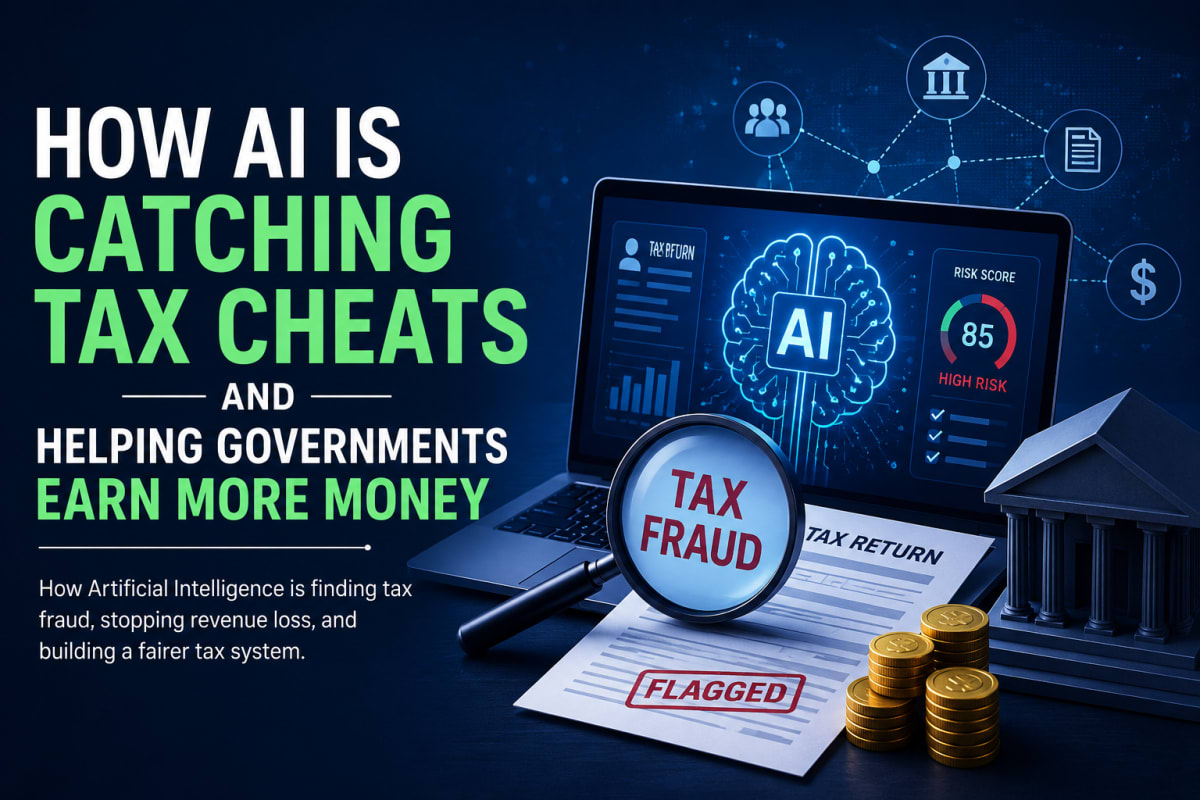
How AI Is Catching Tax Cheats — And Helping Governments Earn More Money.
Tax evasion is not a new problem. Every year, in every country, governments lose huge amounts of money because some people don't pay the tax they owe. In the United States alone, the gap between tax owed and tax actually collected is about 496 billion dollars every year. In the United Kingdom, this gap is around 36 billion pounds a year. This is not small money. It is bigger than the full budget of many small countries.
So how can a government check millions of tax returns and find out who is lying and who is telling the truth? In the past, humans did this job. Tax officers sat down, checked files one by one, and sent notices when something looked wrong. But now, with millions of people filing taxes every year, no human team can check every single file by hand. This is where AI comes in.
How AI Catches Tax Cheats.
First, let's be clear about one thing. AI is not magic. It cannot just look at someone and say "this person is a cheat." What AI actually does is find patterns. When thousands or millions of honest tax returns are filed, a normal pattern forms — income, expenses, and deductions usually match up in a certain way. When one tax return looks very different from this normal pattern, AI notices it right away.
The American tax agency, called the IRS, is a good example. Their AI systems run several times a year, and they keep learning more each time. If someone's income looks very different from last year, or their deductions are too high, or the numbers are too round — like writing exactly 5000 or exactly 10000 for every expense without proper calculation — AI flags this return for a closer look. AI can do this much faster than any human, and it can look at much more data at one time.
The IRS is now also paying close attention to big companies and very rich people. For example, AI was used to study 75 of the biggest partnership companies in the US, each with more than 10 billion dollars in assets. Big businesses often have very complex structures, and it is easier to hide tax cheating inside that complexity.
In the United Kingdom, the tax agency HMRC recently signed a deal worth 175 million pounds with a company called Quantexa. This AI system does not just look at one file at a time. It finds connections between different companies, fake companies that exist only on paper (called shell companies), and bank accounts. So if someone is hiding money through five different companies, this system can connect all five and show the real picture. This kind of work used to take human investigators many months. Now it can take just minutes.
AI Is Not Only About Catching Cheats.
Here is something interesting. AI is not only used to catch people doing something wrong. It is also used to help honest taxpayers. The IRS says they also use AI to tell people when they missed claiming a tax credit or deduction they were actually entitled to. So AI works on both sides — catching cheats, and also helping honest people get the benefits they deserve.
Also, voice bots and chatbots have answered millions of phone calls from taxpayers. This means people don't have to wait for hours just to ask a simple question.
Step By Step: How Governments Can Use AI To Increase Tax Revenue.
If any government or tax department wants to use AI to collect more tax and catch more cheats, here is a simple step by step way to do it:
1. Collect and clean the data first.
AI only works well when it has good, clean data. Bank records, property sales, and old tax returns all need to be connected together. This is the first and most important step.
2. Build a model that learns patterns. Show the AI thousands of old cases, both real cheating cases and simple honest mistakes. It is very important for AI to tell the difference between the two, or else honest people will get troubled for no reason.
3. Give every tax return a risk score.
Not every file needs equal attention. AI can rank returns by risk, so human officers only spend their time on the files that really look suspicious.
4. Add real-time checks.
The biggest benefit of AI is that problems can now be caught at the time of filing, not years later. This gives the taxpayer a chance to fix small mistakes quickly, and saves the government from running expensive audits later.
5. Track shell companies and complex. structures.** Big tax cheating is often hidden across many companies, not just one. AI can connect these hidden links and find out who is really behind the money.
6. Always keep a human checking the final decision.
This step matters the most. AI can also make mistakes. In one study, taxpayers claiming a low-income tax credit called EITC were found to be audited more often if they were Black, simply because of a flaw in the algorithm. So a human must always review the final decision, to make sure no one is wrongly punished.
7. Measure results and keep improving.
The work does not stop after building the system. Every year, governments must check how much new revenue came in, how many mistakes happened, and where the AI model needs improvement.
Final Thought.
AI has made tax collection much stronger than before. Finding real threats among millions of files now takes minutes, not months. But with this power comes responsibility too. The bigger the power, the bigger the care needed — so that technology catches the real big cheats, and honest common people don't live in fear for no reason.
Comments (1)
Please sign in to join the conversation.