

Using AI to Actually Understand the Quran Instead of Just Reciting It.
Last September my manager restructured the whole team over email, on a Thursday, and my name wasn't on the new chart. I found out from a group chat before HR even called me. That night I couldn't sleep. I kept re-reading the email looking for a hidden meaning that wasn't there. Around 1am I gave up trying to sleep and opened the Quran app on my phone, mostly out of habit, not faith. I typed "verses about losing something" into the search bar because I didn't know what else to type.
What came up wasn't a magic cure. It was a handful of verses about hardship being followed by ease, with a translation that actually made sense to me instead of the stiff, old-fashioned English I grew up hearing in Friday sermons. I read them twice. I didn't feel fixed. But I felt less alone with it, which was enough to fall asleep.
That's really the whole point of this piece. Not that AI will save your faith or your week. Just that the tools sitting on our phones can be pointed at something better than doomscrolling, if we actually use them for that.
What These Tools Are Actually Doing.
An AI-powered Quran app isn't thinking or feeling anything. It's matching your search words against a huge database of translations, tafsir notes, and audio recordings, then showing you the closest matches in under a second. That's it. No spirit, no intention, no understanding of what losing a job means to you. The understanding part is still yours. The app just gets you to the right page faster than flipping through a printed Mushaf with an index at the back.
The Translation Problem, and How I Actually Fixed It.
I grew up reciting Surah Yasin at gatherings without knowing what half of it meant. Classical Arabic doesn't map cleanly onto English, and a lot of printed translations from the 1930s and 40s use words like "verily" and "lo" that nobody talks like anymore.
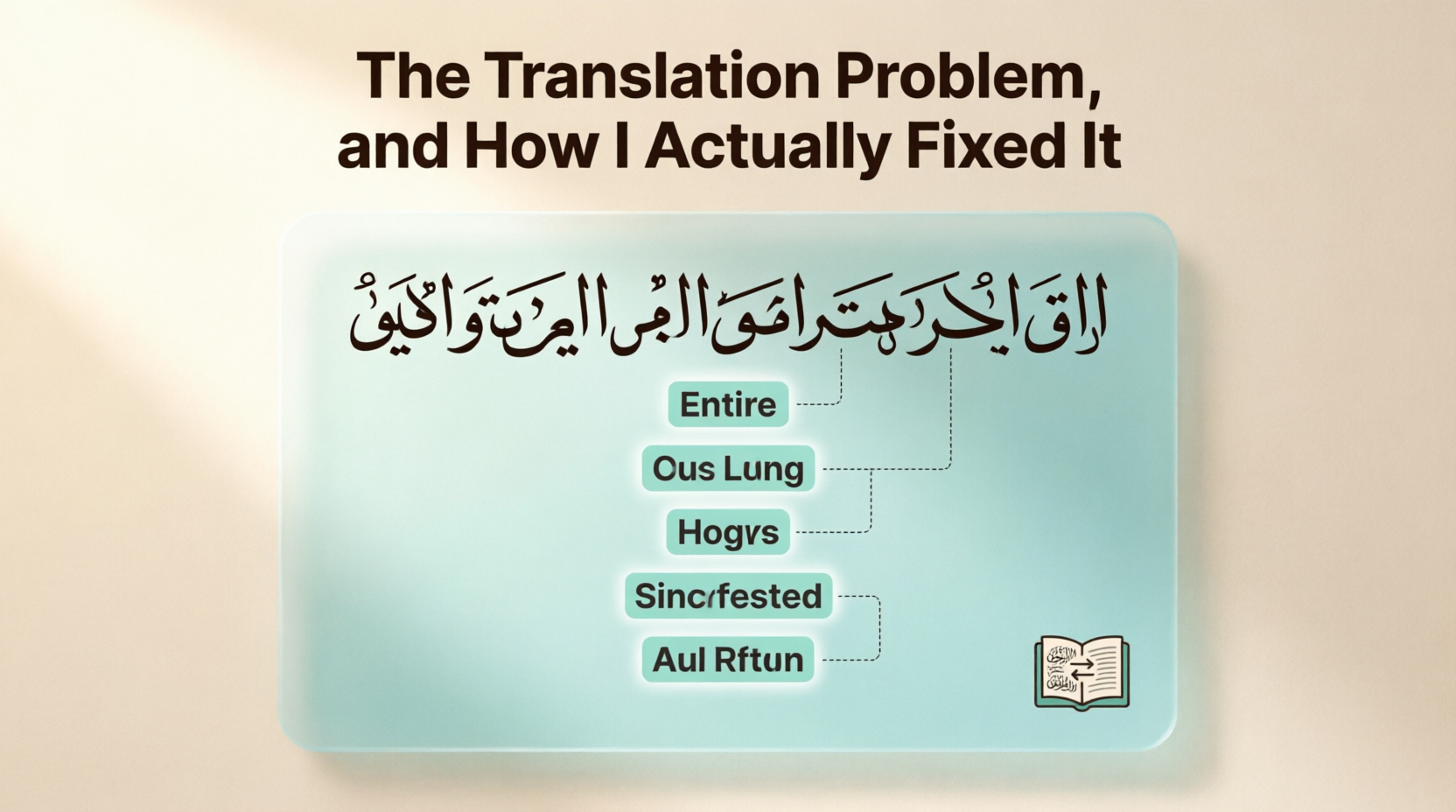
What changed things for me was switching to an app that lets you tap a single word in the Arabic text and get its literal meaning, root, and a plain-English sentence, instead of only showing a full-verse translation. Quran.com does this, and so does the Ayah app. Tapping word by word through a verse I'd recited a hundred times as a kid, and realizing I'd never actually known what three of the words meant, was honestly a bit humbling.
If you want to try this yourself: open the app, pick a short surah you already know by heart, and go word by word instead of reading the block translation underneath. It's slower. That's the point.
[Suggested image here: a screenshot of the word-by-word translation view, showing the Arabic word, its root, and the plain-English meaning stacked underneath. Take your own screenshot from the app so it isn't a copy of someone else's.]
Fixing My Recitation Without Being Embarrassed.
I'm 34 and I still mispronounce certain letters, the ones that don't exist in English, like the heavy "d" in "Dhad." A hafiz corrected me on it once in front of six other people at a gathering and I was too embarrassed to ask him to repeat it slower.
The Tarteel app listens to you recite through your phone's microphone and flags the specific word you said wrong against the correct pronunciation, privately, with nobody else in the room. I use it at night after everyone's asleep. It's not a substitute for a real teacher, and it has gotten things wrong before, especially with background noise, once flagging a word I know I said correctly because my fan was on too loud. But it's the difference between practicing an embarrassing mistake alone until I fix it, versus avoiding practice altogether because I don't want to be corrected in front of people again.
I still see that hafiz every Friday. I just don't need him to catch every single mistake anymore, only the ones I genuinely can't hear myself making.
The other habit that helped more than I expected was picking one reciter and sticking with him. I listen to Mishary Alafasy's recitation of whatever surah I'm working on before I try it myself, a few times over, just to get the rhythm into my ear before I attempt the harder letters. Some apps let you slow the audio down without changing the pitch, which is genuinely useful for catching where a Qari draws out a letter that I usually rush through.
What My Actual Memorization Schedule Looks Like.
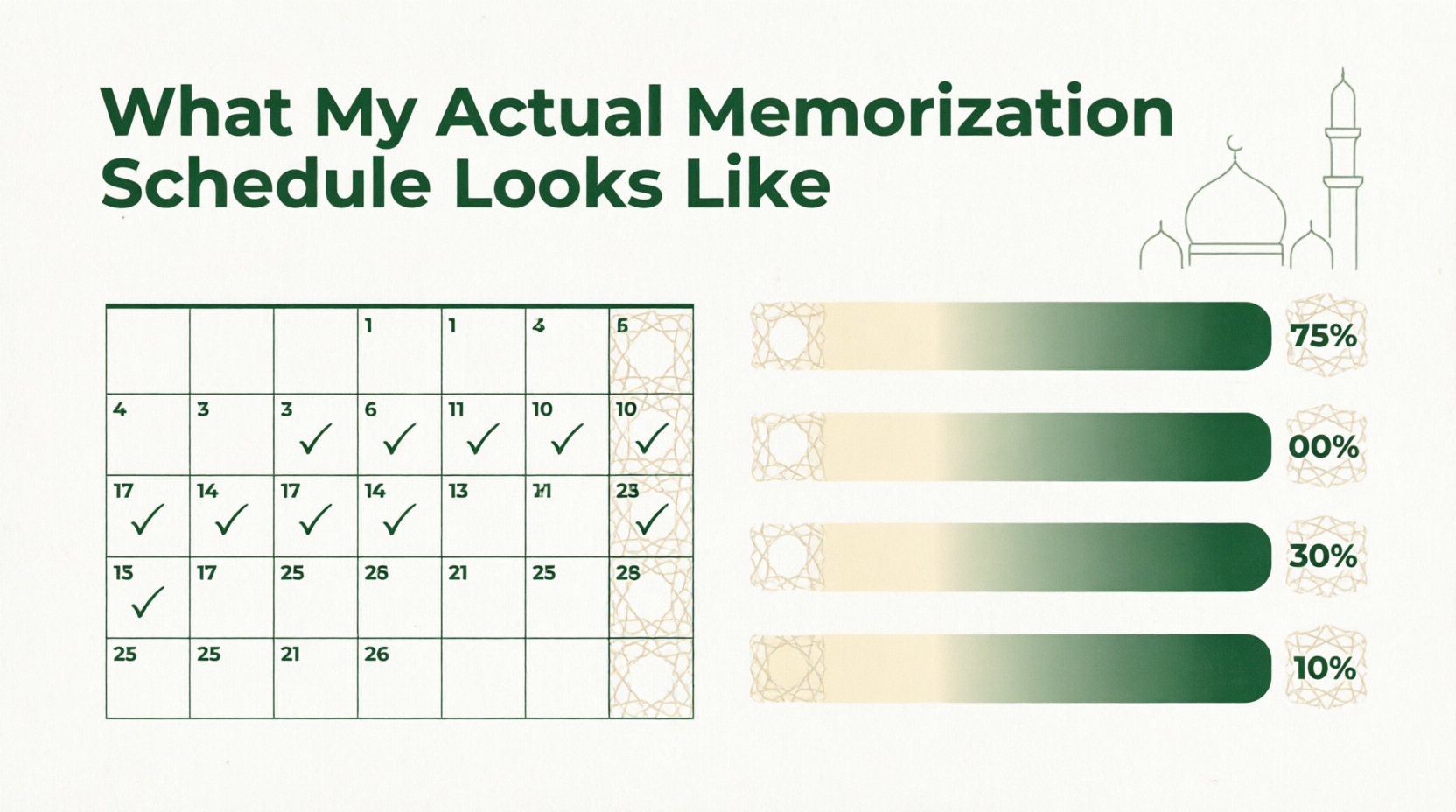
I'm trying to memorize Juz Amma, the last section of the Quran, and I have maybe fifteen minutes most days, not more. I used to try to do it the old way, repeating a page fifty times, and I'd give up after four days because it felt endless.
Now I use a spaced repetition memorization app that tracks which verses I keep messing up and brings them back more often, the same idea flashcard apps use for learning a language. I'm on day 41 as I'm writing this. I've got through An-Naba and half of An-Nazi'at. It's slow. It's also the longest I've stuck with memorizing anything in years, and I think it's because the app removes the guesswork of what to review each day.
The part I didn't expect was how it handles the verses I keep forgetting. There's one line in An-Naba about mountains that I've mixed up with a similar sounding line three separate times. Instead of moving on and letting me quietly forget it, the app keeps surfacing that exact line every two or three days until I stop getting it wrong. A printed page can't do that. My own memory of what I struggle with is unreliable, and honestly a little forgiving of itself.

Where I Got This Wrong Once.
About two months into using these apps, I read a footnote under a verse about patience that gave a fairly casual, oversimplified explanation, and I repeated that explanation to my sister like it was settled scholarly opinion. She's studied a bit more than me and pointed out that the actual scholarly discussion on that verse is more layered than a two-line app footnote could ever capture. She wasn't wrong. I'd let a convenient explanation replace the harder work of actually asking someone who studies this seriously.
That's the real risk with these tools. Not that they're evil, just that they're fast and confident, and it's easy to mistake fast and confident for correct.
Filtering Out the Noise, Which Actually Worked for Me.
I muted a specific list of keywords on my phone, ones tied to accounts I noticed I always argued with in the comments, and I set my screen time limit on Instagram to 40 minutes a day. When I hit the limit, instead of the usual "time's up" screen, I set my reminder app to show one verse instead. It's a small trick. Some days I still tap through it anyway. But on the days I don't, I've noticed I go to bed less wound up.
[Suggested image here: a screenshot of the screen time limit screen showing your own verse reminder instead of the default lock screen. Again, use your own phone for this rather than pulling one off Google.]
Questions I Actually Get Asked.
My cousin asked me if using an app instead of a teacher is basically cheating. My honest answer: it depends what you're using it for. Looking up what a word means, or fixing your pronunciation between lessons, isn't the same as asking an app for a religious ruling on something serious, like inheritance or divorce, where you genuinely need a person who's studied this for years and can ask you follow-up questions an app never will.
My mother asked if these apps are reliable. I told her what happened with the footnote I mentioned earlier, and my honest advice now is to treat anything an app tells you as a starting point, then check it against something like Tafsir Ibn Kathir or an actual scholar you trust, especially before repeating it to someone else as fact.

Where I've Landed With This.
I still don't have this figured out. Some weeks I use the apps every day, some weeks I forget for ten days straight and feel guilty about it. What's actually changed is smaller than I expected. I read a translation before Fajr most mornings now instead of checking my phone for messages first thing. I know what Juz Amma actually says now, the meaning behind the words, not just the tajweed, the melody and rhythm I'd already had memorized without ever attaching meaning to it. And on nights like that one in September, I have somewhere better to point my phone than a group chat that isn't going to make me feel any better.
That's not a transformation story. It's just a slightly different habit than the one I had a year ago, built with a tool that didn't exist for my parents' generation, used by someone who's still figuring most of this out as he goes.
Comments (0)
Please sign in to join the conversation.
No comments yet. Be the first to join the discussion!