
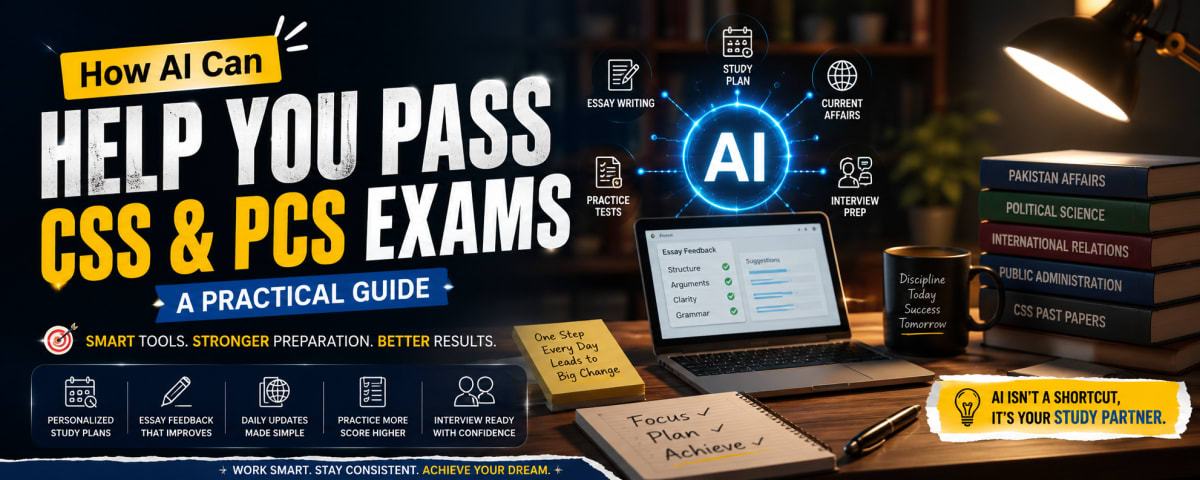
How AI Can Help You Pass CSS and PCS Exams: A Practical Guide.
By someone who's been through the grind.

Let Me Tell You About Bilal.
Bilal from Multan had a wall full of colorful motivational quotes. Three fat guidebooks with the corners folded so many times they'd gone soft. A WhatsApp group where forty people shared notes every day and somehow nobody shared anything that actually helped.
He attempted CSS three times. Three rejections.
Not because he was lazy. The guy studied harder than anyone I knew — harder than me, if I'm being honest. He just didn't have anyone to look at his essay at midnight when his brain was finally, finally working. Nobody to explain Pakistan Affairs at 2 AM when the panic kicks in and every fact you ever learned suddenly feels like it belongs to someone else's memory.
His story isn't unique. Open any CSS Telegram channel right now and you'll find the same complaint, copy-pasted in a hundred different voices: *"I get the concept but I can't write it properly."* Or: *"My academy teacher checks my work once a week, and by the time he does, I've already forgotten what I even wrote."*
This was never a Bilal problem. It's a system problem.
And here's the part that matters — the system hasn't changed one bit. The exam is still brutal. The syllabus is still a monster. But the tools sitting around the system? Those have changed completely. Most students just haven't realized it yet.
What Exactly Are We Talking About.
CSS — Central Superior Services. Pakistan's biggest exam. Clear it and you're staring at Deputy Commissioner, Assistant Commissioner, Police Service, Foreign Service — the jobs that genuinely run the country from the inside. The syllabus is massive enough to make a confident person doubt themselves. And the pass rate? Lower than the odds of winning a raffle you don't even remember entering.
PCS — Provincial Civil Service. The state-level version. In Pakistan, it lands you Tehsildar or Section Officer. In India, it sits right below UPSC, running the state machinery while UPSC runs the national one.
Here's something that genuinely surprised me when I dug into this: every single country runs this same game. Different acronym, same hunt — find the sharpest minds, hand them the keys to government.
Pakistan: CSS, PCS
India: UPSC (national), PCS (state)
UK: Civil Service Fast Stream
US: Foreign Service Officer Test, federal exams via USAJOBS
Canada: Public Service Commission exams
Bangladesh: BCS
Same struggle, wearing a different uniform. Same sleepless nights. Same parents standing at the door asking, *"beta, result kab aayega?"The only real difference today is this — students everywhere are quietly using AI to close the gap. Nobody's cheating. They're just finally getting help when no one else is awake to give it.

The Coaching Center Problem Nobody Wants to Say Out Loud.
Let me just say this directly, because everyone tiptoes around it.
Places like Howfiv, Kips, Cantt Coaching Center in Pakistan — or the big UPSC academies lined up across Delhi — they know what they're doing. Decades of experience, real results, real track records. Nobody's disputing that.
But here's the part that stings: they cost real money. Lakhs of rupees, sometimes more. And if you're sitting in a small house in Dera Ghazi Khan, or a quiet town somewhere in Bihar where the nearest "good academy" is a six-hour bus ride away — that price tag isn't just expensive. It's a locked door.
So what actually happens? Sharp, capable students from smaller cities either give up before they start, or they go it alone — books, YouTube, sheer stubbornness — while competing against kids who grew up with the best teachers in Lahore or Delhi sitting across the table from them every week.
That gap used to feel permanent. Like something you were simply born on the wrong side of.
It isn't permanent anymore.
A free AI tool will never replace a genuinely good teacher. But it does one thing that no academy, no matter how expensive, has ever managed to do — it's *always there*. At 3 AM when the concept finally starts to click and you're terrified you'll forget it by morning. On a Sunday when the academy gates are locked. Without ever once charging extra for a "doubt-clearing session." That kid in the small village suddenly has something in his hands that quietly levels the field, just enough to matter.
Now let me actually show you what this looks like. Five methods. Things I've watched work, not theory I read somewhere and decided sounded nice.

Method 1: Stop Losing Your Mornings to "What Do I Even Study Today".
The CSS syllabus is so enormous that most students freeze before they even open a book. They stare at the reading list, feel the weight of it land on their chest, and end up scrolling Instagram for an hour because deciding where to begin feels harder than actually studying.
Here's exactly what to do.
Open ChatGPT or Claude — doesn't matter which, both handle this well. Tell it your exam, your optional subjects, and how many months you've actually got left. Ask for a week-by-week plan. Not some generic one-size-fits-all template — push it to break the syllabus into daily chunks that fit *your* real schedule, your job, your sleep, your life.
The real secret is what happens after. Check in every single week. Tell it honestly what you finished and what you skipped — it's not your mother, it won't sigh and look disappointed. Ask it to adjust the plan based on what actually happened, not what you wished had happened. And build in short revision days every couple of weeks without fail. Old topics fade faster than you think, and there's nothing worse than opening a chapter two months later and realizing you've forgotten you ever read it.
The result is simple: no more morning confusion, no more standing in front of your bookshelf paralyzed. The plan exists. You just follow it.
Method 2: Fix Your Essay Writing or Watch It Quietly Sink Your Attempt.
I'll say something that sounds harsh but isn't meant to be cruel — it's just true. Essay writing destroys more CSS attempts than any other single paper. And it's almost never because students don't know the topic. They know it cold. It's because they never get real, honest feedback on *how* they're writing it.
Picture this. You write an essay. You read it back and think it's genuinely strong. But your third paragraph quietly repeats your first one. Your conclusion just stops — it doesn't actually conclude anything. You've dropped in a few impressive-sounding words that don't quite fit where you put them. Your arguments don't connect to each other the way you think they do.
You don't catch any of this. You can't. You wrote it — you're too close to your own sentences to see their flaws.
A good teacher would catch it instantly. But if you're studying alone, or your academy only checks essays once a week, you keep repeating the exact same mistakes for months without anyone telling you.
Here's the fix.
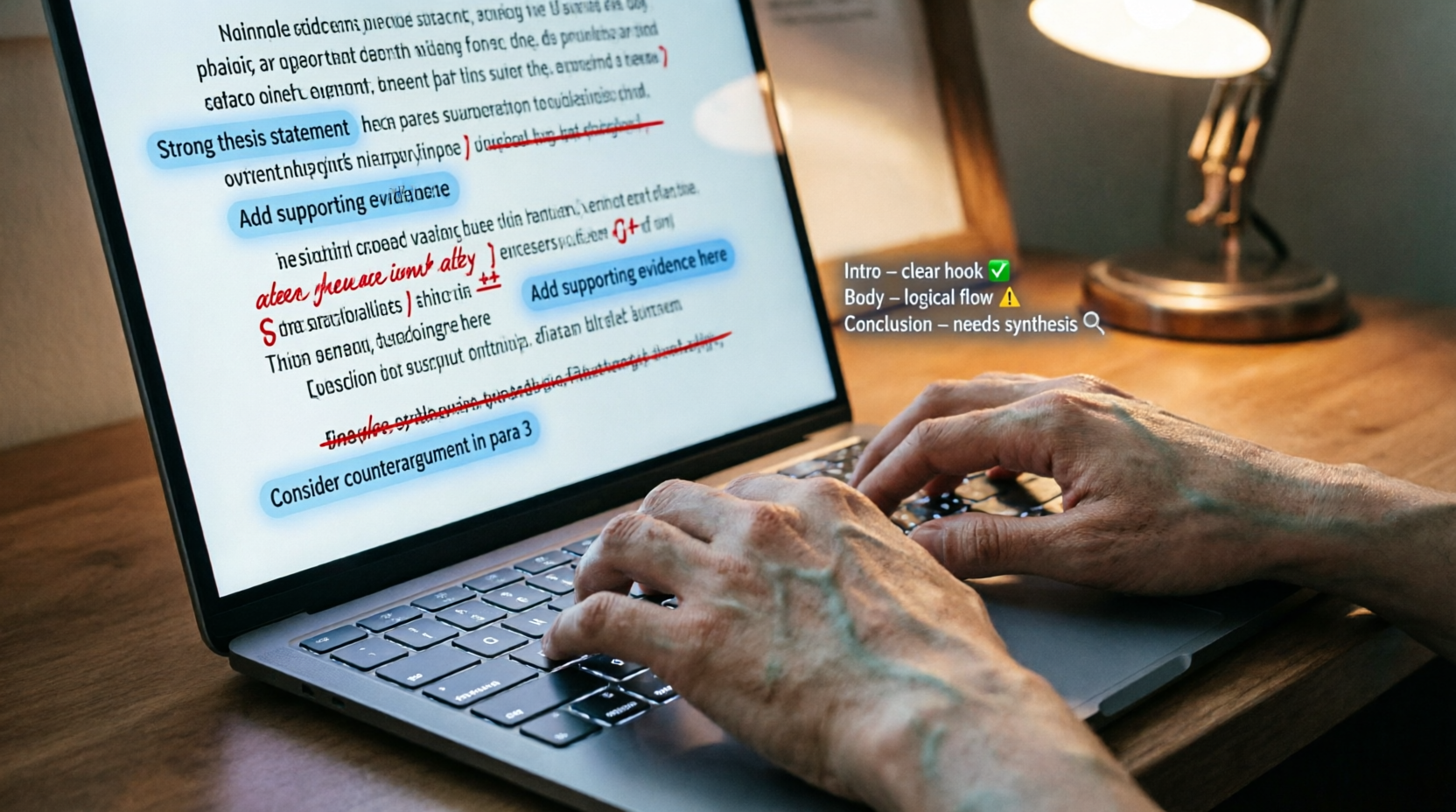
Pick a past paper topic. Set a timer. Write it exactly like exam conditions — no notes, no peeking, no cheating yourself out of the practice. Then paste it into ChatGPT and ask it to check grammar, structure, and flow.
But don't stop there — that's the mistake most people make. Push it harder. Ask directly: "Where does my argument get weak?" "Where am I repeating myself without realizing it?" "Does my conclusion actually conclude anything, or does it just stop?" Then compare your original outline against what it points out. You'll be stunned by what you missed.
Rewrite it. Do this weekly — write, get torn apart gently, rewrite. It's tedious. It's genuinely boring some weeks. It works anyway.
A few months of this sharpens your writing in a way that reading a hundred sample essays never will. I mean that.

Method 3: Current Affairs Without the 2 AM Panic-Reading.
Current affairs is exhausting by design. It changes every single day. You cannot read every newspaper cover to cover — nobody actually does this, no matter what the toppers claim in their polished interview videos.
Here's a way to actually handle it without losing your mind.
Every morning, ask the AI for bullet-point summaries of the major national and international news. Then do the smart part — ask it to connect that news directly to your syllabus. "How does this connect to Pakistan's foreign policy topics?" "Is there a constitutional angle hiding in this story?"
Start a single notes file. Organize it month by month. By exam time, you'll be holding a real reference document built quietly over months — not something stitched together in a panic the night before, full of holes.
Once a month, ask it to quiz you on everything that happened in the last thirty days. Whatever you get wrong, write it down and go back to it. That's the topic your brain is actually weak on, not the one you assume you're weak on.
This keeps you sharp without burning you out. You stop checking the news every hour out of anxiety. You let the AI filter and connect it, and you spend your actual energy on understanding, not collecting.

Method 4: Practice Tests, Any Time You Want Them
Competitive exams come down to one unglamorous, unsexy truth — practice, and then more practice. But good practice material used to mean expensive guidebooks or waiting around for your academy to print the next test.
Not anymore. That barrier is gone.
Finish a chapter? Tell the AI. Ask for twenty to thirty MCQs in exam style. Try them on paper first — no peeking at the answer key, that discipline matters more than people admit. Then check your answers and ask it to explain the wrong ones in plain, simple language. Ask for more questions, specifically targeting whatever you just got wrong.
This isn't just convenient — it's unlimited. You can generate a test at 3 AM if that's genuinely when your brain decides to wake up. You can drill the exact chapter you're weak in until it stops feeling weak. You can repeat the same topic ten times in one week if that's what it takes for it to finally click.
And the best part — it costs nothing. That used to be the wall between a rich kid's prep and a poor kid's prep. That wall is gone now.

Method 5: Don't Let the Interview Undo Everything You Built.
I've watched genuinely brilliant students clear the written exam and then freeze completely in the interview room. They can write a flawless essay. They know Pakistan Affairs cold. But the second a real person looks them in the eye and asks a question, their voice cracks, they start rambling, and everything they knew evaporates.
Why does this happen? Because they spent two years reading and writing, and almost zero hours actually speaking their answers out loud to another human being.
So try this instead.
Ask the AI to roleplay as an interview panel. Have it ask the typical questions — your background, your province, current issues, the usual curveballs. Here's the part people skip: answer out loud. Don't type it. Speak it, the way you'll have to speak it in that room.
Then feed your spoken answer back — transcribe it, or just tell the AI what you said — and ask for honest feedback. Not just on content. On confidence, on clarity, on whether you sound like you believe what you're saying. Push it to ask tougher follow-up questions, because that's exactly what a real panel does. They don't ask one question and politely move on. They push, and push again.
Fifteen minutes a day, especially in the weeks before the interview, changes everything. You get comfortable hearing your own voice answer under pressure. You learn to think while standing, not just while sitting with a pen. No book on earth teaches you that.
Let's Actually Have the Honest Debate
Not everyone is on board with AI anywhere near civil service prep. And to be fair, some of what they're saying is worth sitting with for a minute.
Senior bureaucrats and old-school coaching instructors argue that an exam built to test original thinking and judgment has no business letting a machine shape someone's essays or interview answers. If every candidate is leaning on the same AI, are they actually thinking for themselves anymore, or just sounding polished and rehearsed in identical ways?
That's not a paranoid concern. It's a fair one.
But here's my honest counter: coaching academies have been running this exact playbook for decades. Pre-written essay templates. "Expected answer" sheets memorized by thousands of students word for word, year after year. At least with AI, the practice is personalized to *you* — your weak points, your actual writing, your actual voice. The student still does the thinking. Still does the writing. Still does the rewriting. Nobody is handing the exam itself over to a chatbot in the exam hall — that's simply not how any of this works.
The way I see it: AI is a tool. Same category as a good teacher, or a well-structured guidebook. The real question was never *should you use it.* The real question is whether you let it make you soft, or whether you let it make you sharper.
Students Abroad Are Doing the Exact Same Thing.
This isn't some Pakistan-only trend. Civil service aspirants across the world are using AI in almost identical ways.
In the US, Foreign Service candidates use it to draft policy memos and stress-test their own reasoning before anyone else sees it. In Canada, PSC candidates work through tricky situational judgment questions — those "pick the best workplace response" scenarios — and ask the AI to explain exactly why one option beats another, a kind of reasoning practice that's brutally hard to get from a textbook. In India, UPSC aspirants feed entire NCERT textbooks into AI tools to get bite-sized notes back, and practice mains answer writing with instant feedback instead of waiting two weeks for a red pen. In Bangladesh, BCS candidates use it to simplify dense English material and build last-minute revision notes that don't read like a translated legal document.
See the pattern threading through all of this? AI isn't replacing the grind anywhere on earth. It's just removing the waiting. Nobody's stuck staring at the clock for a teacher's free hour or an academy's Tuesday slot anymore. Help shows up the second it's actually needed — not three days later when the question's already gone cold.
Some Warnings I'd Give My Own Brother
AI is genuinely useful. I use it myself. I tell people to use it. But let's not pretend it's flawless, because pretending that will hurt you eventually.
It gets recent facts wrong sometimes. Dates, statistics, official names — these need a quick double-check against an actual newspaper or a government website before you trust them in an answer sheet. Never assume everything it hands you is correct just because it sounds confident.
It also cannot walk into the exam hall and sit the paper for you. No matter how impressive your chat history looks at midnight, that confidence doesn't transfer into the exam room on its own. Treat it like a patient, endlessly available study partner — not a shortcut, not a replacement for the actual work. The studying, the writing, the revising — that still has to come from you, every single time.
And one more thing, the one that matters most: don't let it make you lazy about thinking. If you start outsourcing everything to it, you'll quietly lose the muscle that lets you reason through a hard question on your own. Use it to sharpen that muscle. Never to retire it.

What I Actually Think.
CSS and PCS are tough. Genuinely, brutally tough. But tough has never once meant impossible.
With a clear plan, daily practice, and smart use of AI, a sincere student from any background, in any country, can now prepare at a level that used to require expensive coaching and a lucky set of connections. The tools are free. They're sitting right there, open to anyone willing to actually use them.
What's left — the one part no AI on earth can do for you — is showing up every single day. Opening the book on the day you don't feel like it. Rewriting that essay one more time even though it's tedious. Practicing the interview out loud even though it makes your stomach drop.
That part has always been yours. It still is.
Try these five methods. Build them into your routine, not just a one-time experiment. And give yourself a real, honest shot at standing near the top of that merit list — not just dreaming about it from inside a WhatsApp group at midnight, chai going cold beside you.
About the author: I've been through the CSS process myself. I've seen what genuinely works and what quietly doesn't. This isn't theory pulled from somewhere else — it's what I wish someone had sat me down and told me when I was starting out.
Quick Recap.
1. Study Plan — Get a weekly plan from AI, adjust it honestly every week. Kills decision fatigue, keeps you moving.
2. Essay Writing— Write under exam conditions, get torn apart by feedback, rewrite, repeat. Builds real skill, not just familiarity.
3. Current Affairs — Daily summaries, connected straight to your syllabus. Full coverage, zero burnout.
4. Practice Tests — Unlimited MCQs on whatever you're weak in, whenever you're awake to take them. Free, targeted, repeatable.
5. Interview Prep — Roleplay out loud, get pushed with follow-ups. Builds the confidence
books can't teach.
Good luck. And if you're reading this at 2 AM with a cup of chai going cold beside you and a pile of notes scattered everywhere — you're exactly where you need to be. Keep going.
Shoaib Nasir
Comments (0)
Please sign in to join the conversation.
No comments yet. Be the first to join the discussion!