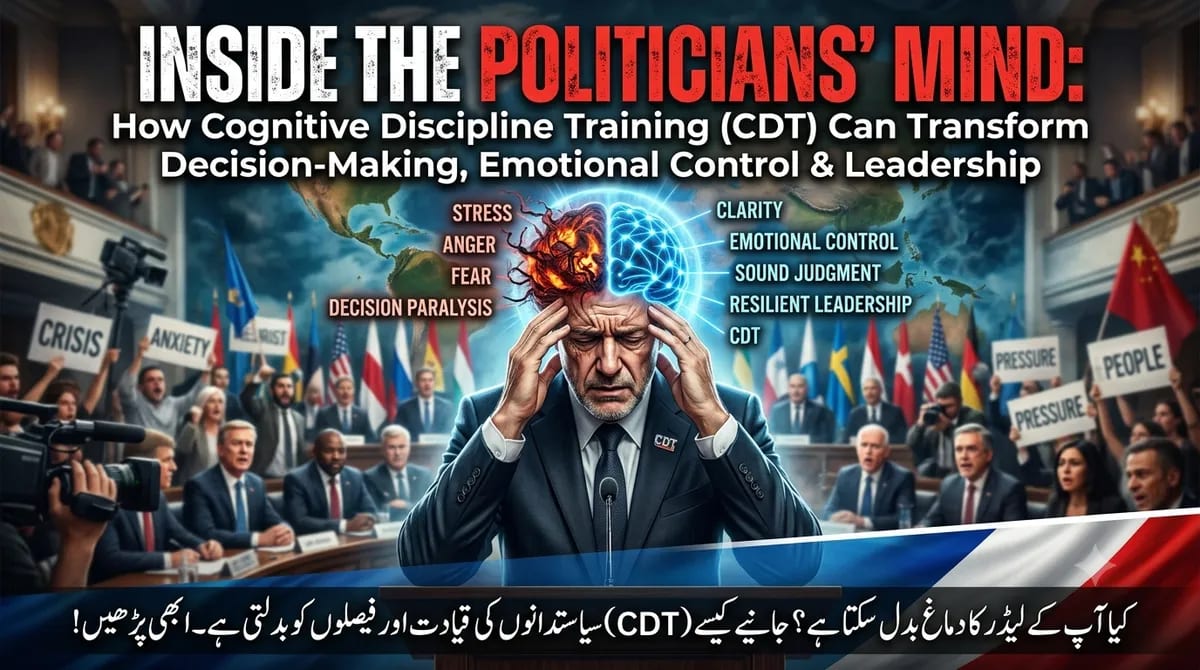
Key Takeaways.
A leader's mind needs training, just like a soldier's or a doctor's.
This training is called Cognitive Discipline Training, or CDT.
CDT has one simple method: pause, look, ask, check, decide, review.
The goal is not perfect leaders. The goal is leaders who think better.
CDT does not tell a leader what to believe. It trains how they think.
There is a full 30-day plan with small daily tasks using just a notebook.
CDT can fail if people just go through the motions without real honesty.
Real change must be seen by others, not just felt by the leader.
This method is not only for politicians. Judges, journalists, and business leaders can use it too.
Inside the Politician's Mind.
Who Trains the Mind That Decides for Millions?
A country can survive a bad speech. It can survive an angry fight. But when a powerful person makes a big choice with a tired mind, many people suffer for it.
So let's ask a question people rarely ask. Who trains the mind of the person who makes choices for all of us?
Soldiers train for danger. Pilots train for emergencies. Doctors train before surgery. Sports players train before every game.
Leaders also face pressure every day. Angry people. Harsh news. Attacks from all sides. Missing facts. Big demands. Money problems. Choices where someone always gets hurt.
But almost no one trains the mind for any of this.
This is where Cognitive Discipline Training, or CDT, comes in.
It is not magic. It will not make a perfect leader. It is one simple idea. What if leaders trained their minds the same way other workers train for hard jobs?
The goal is not perfect leaders. The goal is better thinkers.
What Is Cognitive Discipline Training?
CDT is a way to train the mind. It has seven parts: focus, calm feelings, clear thinking, flexible thinking, careful choices, fair thinking, and honest self-checking.
The whole method is simple. Stop. Look. Ask. Check. Decide. Look back.
Here is what this looks like in real life.
A leader hears harsh words about them. The normal feeling is anger. That anger jumps in fast, before the mind can even think.
CDT builds in a stop.
What just happened? What am I feeling? What are the real facts? What am I guessing without proof? What do I not know yet? What could go wrong if I react right now?
That small stop makes space between the feeling and the action. And in that space, better thinking can happen.
Science shows this is real. Studies show that stress can hurt memory and clear thinking, right when we need them most. This is not because leaders are weak. It is because they are human.
Why Leaders Need This.
Leaders rarely have all the facts when they choose.
A leader hears ten different views from ten different helpers. People want action right away. The news adds more pressure. Some people agree with everything. Others reject everything.
In this storm, the mind falls into old traps.
We look only for facts that agree with us. We stop disagreeing just to keep peace. We feel too sure and forget how unsure we really are. We mix up a strong feeling with a strong fact.
CDT never tells a leader what to believe. It trains the way they think about a belief.
This point matters a lot. A trained mind should never become a mind that just obeys. It should become a mind that truly thinks.
What High-Pressure Jobs Already Know.
Soldiers and other hard jobs all know one thing. Do not wait for the crisis to teach the mind how to act in a crisis.
This does not mean leaders should train like soldiers. Their jobs are not the same. But the lesson is the same. Get ready before the storm hits.
A leader should never find out about their own temper for the first time during a big crisis. A leader should never learn about their own bias for the first time after a plan has already failed.
Training the mind must start long before the pressure gets high.
The 30-Day Cognitive Discipline Program.
This takes only 20 to 30 minutes a day. All you need is a private notebook and true honesty.
Part One: Know Yourself (Days 1–7).
Day 1: Know Your Mind. Write down three choices you made lately. What facts shaped them? What feelings shaped them? What did you just guess? Do not defend yourself. Just watch yourself.
Day 2: The Power of the Stop. Before you react to bad news, stop. Breathe slowly and ask, am I reacting, or am I really thinking?
Day 3: Name the Feeling. When anger, fear, pride, or frustration rises, say its name. You cannot control a feeling you refuse to notice.
Day 4: Face Your Bias. Pick one belief you hold strongly. Go find honest facts that go against it. Do not look for a weapon to attack it. Look to understand it.
Day 5: Say "I Don't Know." Pick one issue where you don't have all the facts. Write down what you know, and what you still need to find out. This is not weak. This is real strength.
Day 6: Sort Fact, Opinion, and Guess. Pick one big issue. Split your notes into three lists: facts, opinions, guesses. This one habit can clear your mind fast.
Day 7: Weekly Look Back. Ask yourself, what did I learn about myself this week? What bad habit showed up? Where did feelings take control? Write the true answer, even if it hurts.
Part Two: Facts and New Views (Days 8–14).
Day 8: Facts Before Feelings. Before a big choice, ask what the facts actually say, not just who is cheering for you.
Day 9: Break the Yes-Men Circle. Ask someone you trust, what am I missing? Then really listen, without jumping in to defend yourself.
Day 10: Hear the Other Side. Listen closely to someone who disagrees with you. Say their point back to them first. Only then answer. Listening is just gathering facts.
Day 11: Three Points of View. Look at one choice through three sets of eyes: the leader, the everyday person, and the person who disagrees. This builds real understanding.
Day 12: Think in Outcomes. For one big choice, picture the best outcome, the most likely outcome, and the worst outcome. Get ready for all three.
Day 13: Look Past the First Result. Ask what happens next, and then what happens after that. Train your mind to see the second and third effects.
Day 14: Weekly Choice Review. Look back at your choices from the past week. Find the patterns that keep repeating in your thinking.
Part Three: Pressure and Rest (Days 15–21).
Day 15: Handle Harsh Words Well. Take one piece of harsh feedback seriously. Ask if there is any truth hiding inside it. You do not have to accept it all to learn something from it.
Day 16: Control the Anger. When anger rises, wait before making a big choice, if you can. Breathe. Step back. Go back to the plain facts.
Day 17: The Ego Check. Ask yourself honestly, am I helping the public, or am I just protecting my own image? This question can feel uncomfortable. That is exactly why it matters.
Day 18: Rest From Stress. Spend a few quiet minutes on slow breathing and just being present. The goal is not zero stress. The goal is a healthier way to handle stress.
Day 19: Turn Failure Into Learning. Pick one past failure. Ask what you controlled, what you missed, and what you would do differently. Turn the failure into useful information.
Day 20: Practice a Crisis. Make up a pretend emergency. Give yourself little time and little information. Make the choice. Then look back at your own thinking.
Day 21: Rest Review. Find out exactly what helps you think clearly again after pressure hits. Even strong leaders need real rest.
Part Four: Fairness and Ownership (Days 22–30)
Day 22: Power Comes With Duty. Ask how this choice will affect people who can never talk to you directly. Think far past the meeting room.
Day 23: Practice Real Care. Pick one issue. Picture the daily life of someone it affects. What do they fear? What do they truly need? Facts matter, but people matter more.
Day 24: Hear the Small Voice. Ask who is most likely to disagree with this choice. Then go find that exact view.
Day 25: Fairness Over Gain. Ask yourself, if this choice helps me but hurts others unfairly, should I still make it? This is the real test of a leader, not of popularity.
Day 26: Think Past the Next Election. Picture someone looking back at this choice ten years from now. What would they ask? Why was it made? What proof was behind it?
Day 27: Full Ownership. Write down what you chose, why, what facts backed it, what risks you took, and what would change your mind.
Day 28: The Decision Room. Bring it all together. Stop. Name the real problem. Check every fact. Name every guess. Weigh the other side. Study what could happen next. Choose. Then explain your thinking out loud.
Day 29: The Leader's Mirror. Go back and read your Day 1 answers. Ask how differently you think now. What is your biggest weak point? What is your biggest strength?
Day 30: The Promise. Make these seven promises to yourself. I will stop before reacting. I will ask before believing. I will listen before judging. I will check the facts before deciding. I will accept not knowing everything. I will learn from every mistake. I will always remember that public power comes with public duty.
The 30 days end here. The training never does.
What Really Happens Inside the Brain?
Let's be honest about the science.
It would be wrong to promise that exactly 30 days of CDT gives a fixed amount of any brain chemical. The human brain is far more complex than that.
Mind training touches focus, memory, learning, and feelings, and all these parts work together in complex ways. Studies show that training can sharpen some mental skills, but that this improvement does not always spread to every part of life on its own.
So here is the honest claim. CDT will not magically rewire your brain in exactly 30 days. But doing it again and again can build stronger habits of thinking and self-awareness.
And those habits can be tested in real life, through real choices and real actions that others can see.
The goal was never to change brain chemicals on a countdown. The goal is to build habits strong enough to survive real pressure.
Where CDT Can Go Wrong.
Every method can fail. Being honest means naming the traps too.
Going through empty steps, writing answers that sound wise but mean nothing.
Using the "stop" step as an excuse to never decide anything at all.
Thinking "I did my 30 days, so I am automatically fair now." This turns the program into a badge instead of a living habit.
Losing touch with real people, treating citizens like numbers instead of humans.
Writing self-reviews that sound honest but hide the real truth. This turns the notebook into a show.
Naming these dangers does not make CDT weaker. It makes it more trustworthy.
But Will Leaders Really Do This?
This is the hard question, and it needs an honest answer.
The leaders who need this the most may never choose it on their own. That is true. But it does not make the idea useless.
There are four ways forward.
The willing path: some leaders truly want to grow. Give them the tools.
The system path: build CDT into party training, government schools, and orientation programs. Make it a normal job skill, not a personal hobby.
The public pressure path: let voters and journalists ask for proof of clear thinking. Not slogans. Real proof. Written reasoning. A wish to say "I was wrong."
The culture path: make mind training a sign of a serious leader, the same way body fitness is expected of a soldier. Change what people respect in a leader.
None of these paths are easy. But the other choice is what we have right now: no training at all.
How Do We Measure Real Change?
Judging yourself is weak. A serious method needs proof that other people can see too.
Before Day 1, ask honestly: Can I stay calm under pressure? Can I truly listen to disagreement? Can I spot my own guesses? Can I look for facts that challenge me? Can I admit I don't know something, out loud? Can I look back at my own mistakes without flinching?
Ask these same questions again after Day 30.
But also track what others can see: How many choices changed because new facts came in? How often did you truly look for disagreement, and can you prove it? How much time passed between bad news and your public answer? How many choices had written reasons before they were announced? How many guesses were written down and checked? How often did you say "I was wrong" in public?
These numbers are hard to fake. And they are easy to track over time.
The real question was never "do I feel changed." The real question is, has my way of choosing actually gotten better in ways other people can see?
The Seven Pillars of the New Political Mind.
Tomorrow's leader needs far more than charm.
Discipline. Clear thinking. Calm feelings. Facts. Care for others. Fairness. Ownership.
This is the true point of CDT. Not to build leaders who never make mistakes, but to build leaders who can spot their mistakes, learn from real facts, truly listen to disagreement, and stand up and own their choices.
What This Is Not.
CDT is not a belief system. It never tells you what to believe.
CDT is not a personality test. It does not measure who you are. It measures how you think.
CDT is not a replacement for democracy. It supports it. It can never replace a free press, free elections, or honest opposition.
CDT is not a promise of good choices. It is a habit that improves your odds.
CDT is not therapy. It is training.
Being clear about these limits builds more trust. And trust matters when you ask powerful people to change how their minds work.
How to Use This Beyond Politics.
Not every reader is a politician, but these ideas go far beyond politics.
Government workers can use it before writing a plan.
Judges can use it before deciding a hard case.
Journalists can use it before printing a story that could ruin someone's name.
Business leaders can use it before choices that affect thousands of workers.
Community leaders can use it before stepping into a local conflict.
Everyday people can use it to judge leaders, not just by what they say, but by how they think.
The method works everywhere. The training travels anywhere.
The Final Question.
A country spends money on roads. It spends money on technology. It spends money on institutions. Maybe it is time we also spent time on the mind behind every public choice.
Because plans do not write themselves. Humans write them. And humans carry feelings, guesses, fears, ambitions, and bias into every choice they make.
That does not make leaders weak. It makes them human.
The answer is not turning leaders into machines. The answer is helping humans become sharper, more trained thinkers.
So before the next crisis, train the mind.
Before the next reaction, stop.
Before the next conclusion, ask a question.
Before the next choice, check the facts.
Before blaming someone else, look in the mirror first.
And before using power, remember the people who will live with what you decide.
One Last Picture.
Picture a leader sitting alone with a notebook before a hard choice.
No cameras. No helpers. No cheering.
Just a pen, one honest question, and the weight of every person who will live with the answer.
That is where real leadership truly begins.
It begins with one simple question: am I just reacting to this moment, or am I thinking clearly enough to truly lead through it?
That one question can spark a 30-day program. Done with honesty, it can grow into a lifelong habit.
A Note on What This Article Is Trying to Do.
This is not a political statement. It belongs to no party and no belief system.
It makes one simple point. The mind that shapes choices for millions deserves the same serious training we give to every other high-pressure job.
Some readers will call this too hopeful. That is fair. Politics is messy, and no notebook alone will fix corruption, media tricks, or broken systems.
But hope is not the same as being naive. It is a starting point. And every real change begins the moment someone dares to ask a better question.
This article asks one: who trains the mind that decides for millions?
Right now, the honest answer is: no one.
That can change.