
How AI and Robotics Are Building the Future of the World.
Not long ago, the word "robot" made people think of metal men in cartoons. Today, a robot might be the arm that packed your parcel, the software that read your blood test, or the sensor that told a farmer exactly when to water his field. Artificial Intelligence (AI) and robotics have quietly moved out of movies and into ordinary life, and they are rewriting the rules of work, health, farming, and business almost everywhere at once.
This article walks through three things. First, the real science behind how AI and robotics are changing the world, step by step, backed by numbers. Second, how America and China are putting this technology to work, along with a fair look at what could go wrong. Third, and most useful for many readers, how developing nations can start using the same tools today, even on a tight budget.
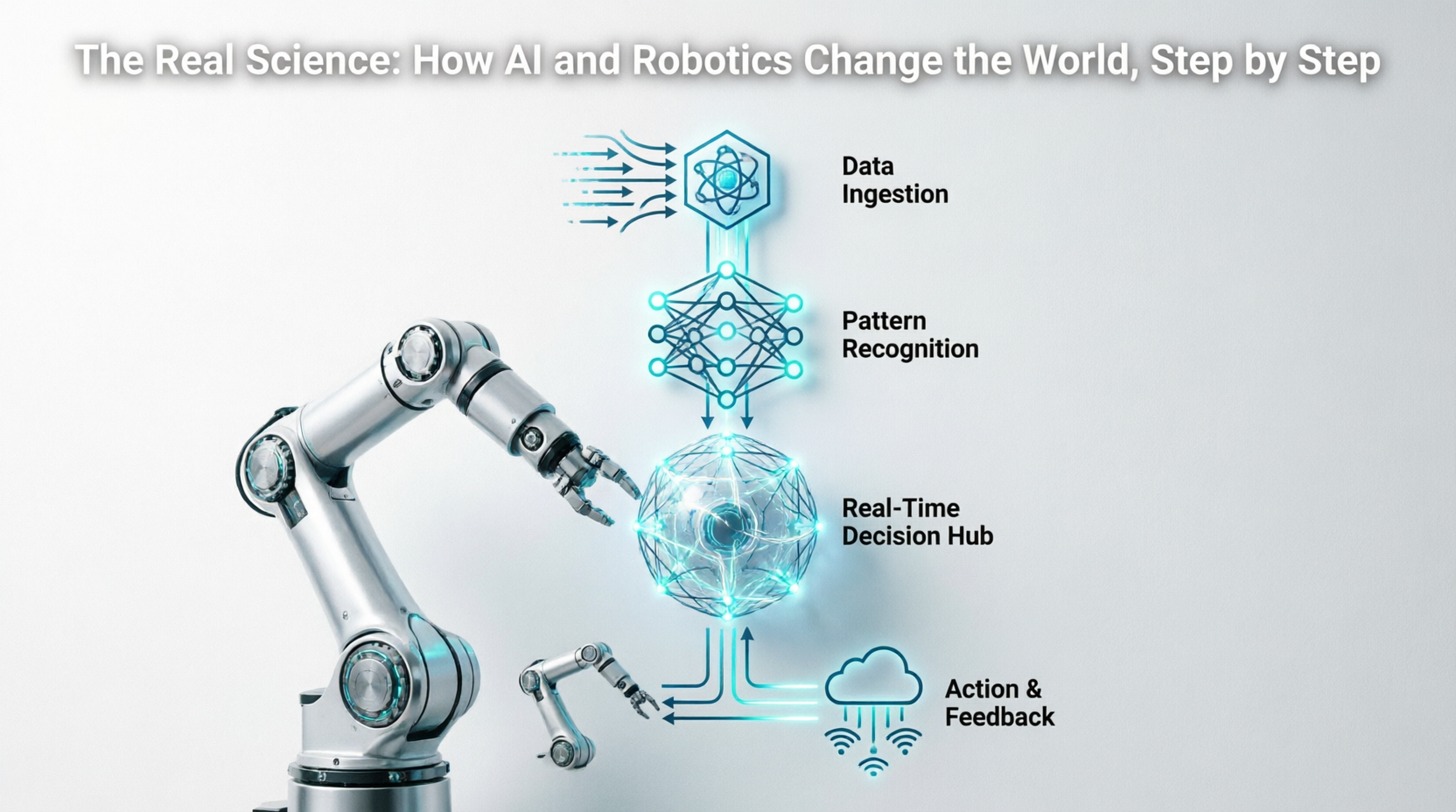
The Real Science: How AI and Robotics Change the World, Step by Step.
AI does not "think" the way a human brain does. It learns by studying massive amounts of data and finding patterns inside it. Breaking this into simple steps makes the whole picture much clearer.
Step 1: Feeding the machine data.
Every AI system starts with data, millions of images, medical records, weather reports, or shopping habits. A machine learning model looks for repeating patterns inside this data. By studying thousands of lung scans, for instance, an AI model can learn what early-stage cancer looks like, sometimes noticing details a tired human eye might miss after a long shift.
Step 2: Turning patterns into predictions.
Once a pattern is found, the system uses it to guess what comes next. A weather AI does not know the future; it compares today's conditions with thousands of similar past situations and calculates the most likely outcome.
Step 3: Automating repeated physical work.
Robotics gives machines a body. Robotic arms in car factories repeat the same precise movement thousands of times a day without fatigue or injury. Warehouse robots follow AI-guided paths to fetch products, cutting delivery time from days to hours.
Step 4: Making decisions in real time.
Newer systems adjust instantly instead of following one fixed rule. A self-driving car reads road lines, other vehicles, and pedestrians at the same moment, then recalculates its next move dozens of times per second.
Step 5: Human and machine cooperation.
The most advanced use of this technology is not replacement, it is teamwork. Surgeons guide robotic tools that filter out natural hand tremors, allowing cuts more precise than an unaided human hand could manage. Farmers use drone-collected data to treat only the exact patch of a field that needs fertilizer, saving money and cutting chemical waste.
Step 6: Linking systems together.
Smart traffic lights, smart factories, and smart farms now share data in real time. A connected system can warn a factory of a machine failure hours before it happens, or reroute city traffic the moment an accident occurs.
Just how big is this shift in numbers? Global consulting firm PwC has estimated that AI could add close to $15.7 trillion to the world economy by 2030, mostly through higher productivity and brand-new products and services. McKinsey's research puts a similar figure near $13 trillion, but adds an important warning: nations that are already ahead in AI could see their economies grow by 20 to 25 percent, while developing countries may only capture 5 to 15 percent of that gain unless they act early. The size of the opportunity is real, but so is the risk of being left behind.
How America and China Are Using This Technology, and What It Could Cost.
Two nations show clearly what large-scale investment in AI and robotics can achieve, though each has followed its own path.
The United States.
has grown its strength mainly through private companies and research universities working closely together. American hospitals already use AI systems to scan X-rays and flag possible tumors faster than a radiologist working alone. Logistics companies operate warehouses where thousands of robots sort and move packages non-stop, and several states now allow self-driving cars to gather real road data every day.
China has taken a more centrally guided route. The government named AI a national priority years ago and has poured funding into research labs, chip manufacturing, and applied automation. Chinese cities use AI-linked camera networks to manage traffic flow and public safety at a scale rarely seen elsewhere. Chinese factories rank among the most automated on earth, and agricultural drones are widely used to help a limited farming workforce feed a population of over a billion people. Some economic forecasts, including work cited by the World Economic Forum, suggest China's GDP could rise by roughly 26 percent by 2030 due to AI alone, the largest projected gain of any single country.
But this progress carries real costs, and honest readers deserve both sides of the story.
The first concern is jobs. The World Economic Forum's Future of Jobs Report 2025 estimates that by 2030, AI and related technology could displace around 92 million existing jobs worldwide, while creating about 170 million new ones, a net gain, but only for workers who manage to retrain in time. The disruption falls hardest on repetitive, routine roles, and workers in lower-income regions, who often have the least access to retraining programs, are typically the most exposed.
The second concern is privacy and surveillance. The same AI-linked cameras that manage traffic can also track individual citizens without their knowledge or consent. Facial recognition systems, predictive policing tools, and large-scale data collection raise real questions about how much power any government or company should hold over personal information. Critics argue that efficiency gains should never come at the cost of basic civil liberties, and this remains an unresolved debate in both developed and developing nations.
The honest lesson from America and China is this: real growth came from sustained investment and clear planning, not overnight luck, but that same growth has arrived bundled with job disruption and privacy trade-offs that every country will eventually have to confront.
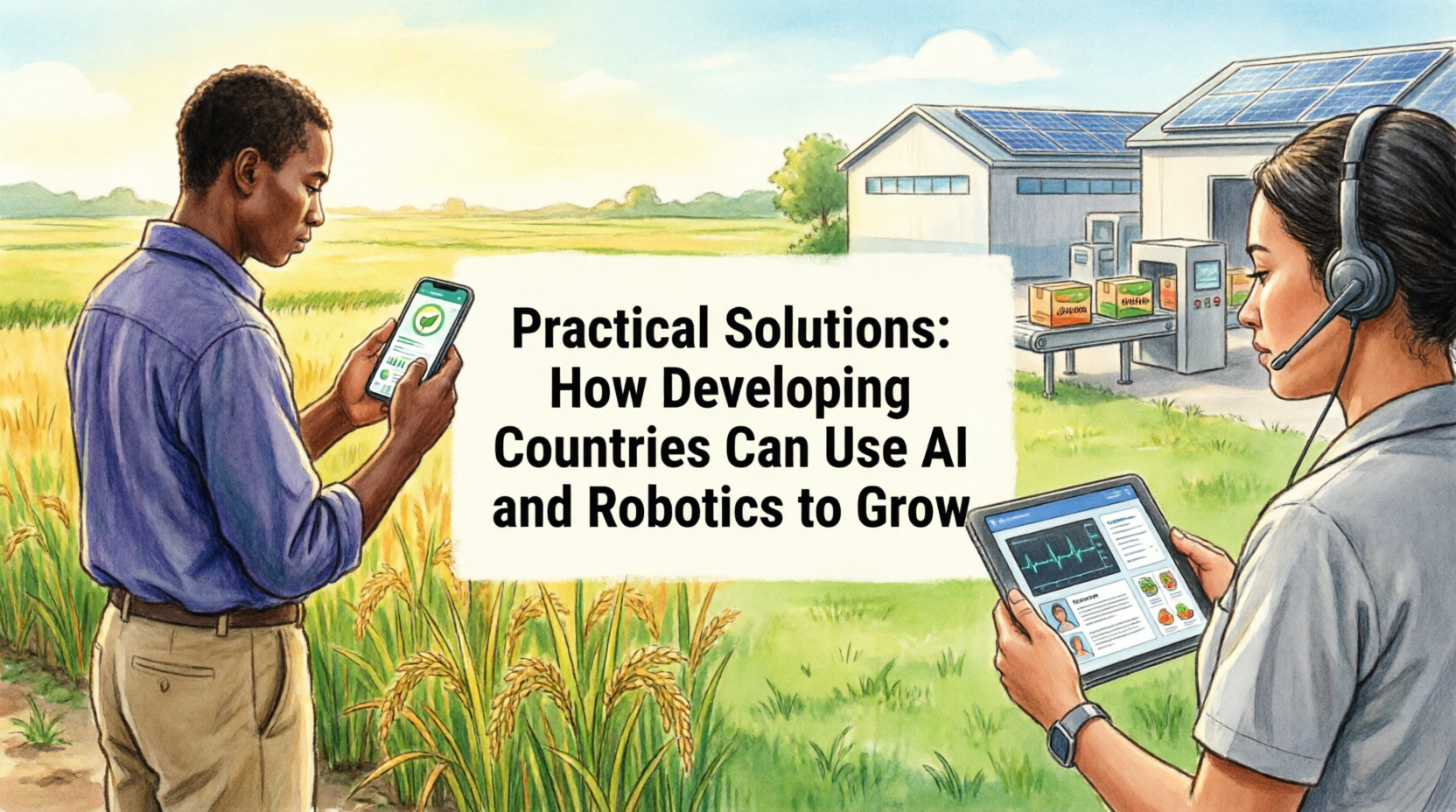
Practical Solutions: How Developing Countries Can Use AI and Robotics to Grow.
Here is the part that matters most for many readers. AI and robotics are not private property of rich nations. The World Bank's 2025 Digital Progress and Trends Report actually found that more than 40 percent of ChatGPT's global traffic in mid-2025 came from middle-income countries, led by Brazil, India, Indonesia, and Vietnam, proof that adoption is already happening from the ground up.
Solution 1:
Smart, low-cost farming tools.** Since agriculture supports most developing economies, even a basic mobile app that predicts rainfall or the right planting date can raise harvests significantly. Apps like PlantVillage Nuru, built with support from Penn State University and used across parts of East Africa, let a farmer photograph a crop leaf on an ordinary phone and get an instant diagnosis of disease, no internet connection required at the point of use.
Solution 2:
AI-supported healthcare in remote areas.** Many villages have no access to specialist doctors. The World Health Organization has backed digital health chatbots designed to give basic health guidance in areas with doctor shortages. Simple diagnostic tools running on an ordinary smartphone can screen for common illnesses and flag urgent cases for a real doctor to review later, extending a physician's reach without replacing their judgment.
Solution 3:
Affordable automation for small businesses. A small shop owner does not need a factory robot. Free tools such as Google's Teachable Machine let anyone train a simple image or sound recognition model in a browser, no coding required, while basic AI chat tools can help a small business answer customer questions or manage simple bookkeeping at little to no cost.
Solution 4:
Building local technical skills.Countries do not need to invent this technology from zero. Free platforms like Khan Academy, along with growing local coding bootcamps, are opening direct paths to global tech jobs. India and Vietnam already show how a skilled young workforce can attract international technology companies to open local offices, bringing income and training with them.
Solution 5:
Mixed human-machine factories.** Instead of replacing all workers with robots, developing nations can combine human labor with limited automation, keeping local jobs alive while raising production speed and quality enough to compete internationally.
Solution 6:
Government-backed digital infrastructure. The World Bank frames the real foundation of AI readiness around what it calls the "Four Cs": Connectivity, Compute, Context, and Competency, meaning reliable internet and electricity, access to computing power, locally relevant data, and trained people. Developing nations can offer tax relief for AI startups, fund technical education, and extend internet access into rural regions to strengthen all four at once.

Facing the Digital Divide Honestly.
None of this works without confronting a hard truth: hundreds of millions of people are still not online at all. According to the International Telecommunication Union's 2025 report, about 94 percent of people in high-income countries use the internet, compared with only 23 percent in low-income countries, and roughly 2.2 billion people worldwide remain offline entirely, most of them in poorer nations. Rural areas lag badly behind cities too, with only 58 percent of rural residents online globally compared with 85 percent in urban areas.
The reasons are not just about missing Wi-Fi routers. Unreliable electricity supply, the high cost of smartphones and data plans, and a shortage of digital skills training all combine to keep people locked out. The World Bank has pointed to a promising middle path here, so-called "Small AI": lightweight, affordable applications designed to run on ordinary phones without needing expensive data centers or constant high-speed internet. These tools cannot replace the need for real infrastructure investment, but they let people start benefiting from AI today, while governments work on the harder, slower task of building roads, power grids, and fibre networks.
Where to Start: Free and Low-Cost AI Tools Available Right Now.
For anyone reading this and wondering where to begin, here are accessible starting points that do not require a large budget:
Google Teachable Machine ,a free browser tool for training simple AI models with no coding needed.
Khan Academy ,free courses covering the basic maths and logic behind AI and data science.
PlantVillage Nuru .
a free crop-disease diagnosis app built for smallholder farmers, usable offline after installation.
Basic AI chat assistants many offer free tiers that small business owners can use for customer replies, translations, or drafting documents.
Local government digital literacy programs – increasingly offered through libraries, schools, and community centers in many developing regions, often at no cost.
Starting small with tools like these, while pushing for better internet access and digital education locally, is a realistic first step rather than an overwhelming leap.

Final Thoughts.
AI and robotics are not luxury tools reserved for wealthy nations, and they are not a risk-free miracle either. America and China demonstrate what heavy, sustained investment can achieve, while also showing the real costs, job displacement and privacy trade-offs, that come with rapid adoption. Developing countries hold their own advantage: they can study these existing models, skip the early mistakes, lean on lightweight "Small AI" tools already built for low-resource settings, and design solutions that fit their own budgets from day one.
The future of the world will not be shaped by machines alone. It will be shaped by the people who choose how wisely, and how fairly, to apply them. Every nation, rich or developing, has a genuine seat at this table. The real question is no longer whether AI and robotics will reshape the world, because they already are. The question is who prepares early enough and thoughtfully enough, to turn that change into lasting, shared growth.
Comments (0)
Please sign in to join the conversation.
No comments yet. Be the first to join the discussion!