
The Growing Role of AI in the Defense Sector.

Armies never stick to old tools for too long. First it was bows, then guns, then tanks and fighter jets. These days something has joined that list that doesn't even look like a weapon — artificial intelligence. It doesn't wear a uniform or hold a rank, and it can watch a camera feed or a radar screen for ten hours straight without losing focus. What makes this technology worth writing about isn't the idea of it, though. It's what it's actually fixing.

The Money Behind The Fixes.
Look at the Pentagon's own paperwork for 2026 — for the very first time, AI and unmanned systems got their own separate budget of $13.4 billion. Almost $9.4 billion of that alone goes to unmanned aircraft, and the rest is spread across underwater drones, ground robots, and the software that connects everything together. Websites that closely follow defense spending, like GovExec and MeriTalk, pointed out something worth noticing — this is the first year these categories weren't buried inside some bigger, vaguer account. That money isn't going toward research for its own sake. It's funding specific fixes for problems armies have struggled with for decades — slow detection, equipment failures, and stretched-thin manpower.
Other countries are putting money behind the same fixes in their own way. India spends close to $50 million every year on military AI, according to a 2026 report from the Council for Strategic and Defense Research, run through its own Defense AI Council and a Defense AI Project Agency, funding 129 approved projects across the army, navy, and air force. That's roughly three percent of what China is believed to be spending, though nobody knows the real figure since Beijing doesn't share it publicly. China funds its version differently — Georgetown's CSET describes it as "military-civil fusion," where anything built inside a regular Chinese AI company can end up used by its military too. Israel took a slower, more expensive route — its air-defense and targeting systems, built by Elbit Systems, Israel Aerospace Industries, and RAFAEL, took years to actually work reliably, which the Bulletin of the Atomic Scientists points to as proof that these fixes take real investment, not a quick copy-paste job.

Fixing The Border That No One Can Fully Watch.
No number of soldiers or patrol boats can physically cover thousands of kilometers of border or coastline, day and night, forever. That's a real limit, not a small inconvenience, and it's exactly the gap AI is being built to close. By combining feeds from satellites, radar, drones, and ground sensors into one live picture, a single system can now watch an entire stretch of border at once and flag the one thing that actually matters, in seconds instead of hours. Poland's battle-management system, shown publicly at IDEX 2026 in Abu Dhabi, works exactly this way. India's Mission Sudarshan Chakra, currently being built by the Defence Research and Development Organisation with its first stage planned for 2030, takes the same idea further, linking surveillance, cyber protection, and physical defense into one system meant to guard an entire country rather than just one stretch of land.
Fixing The Drone Swarm Problem
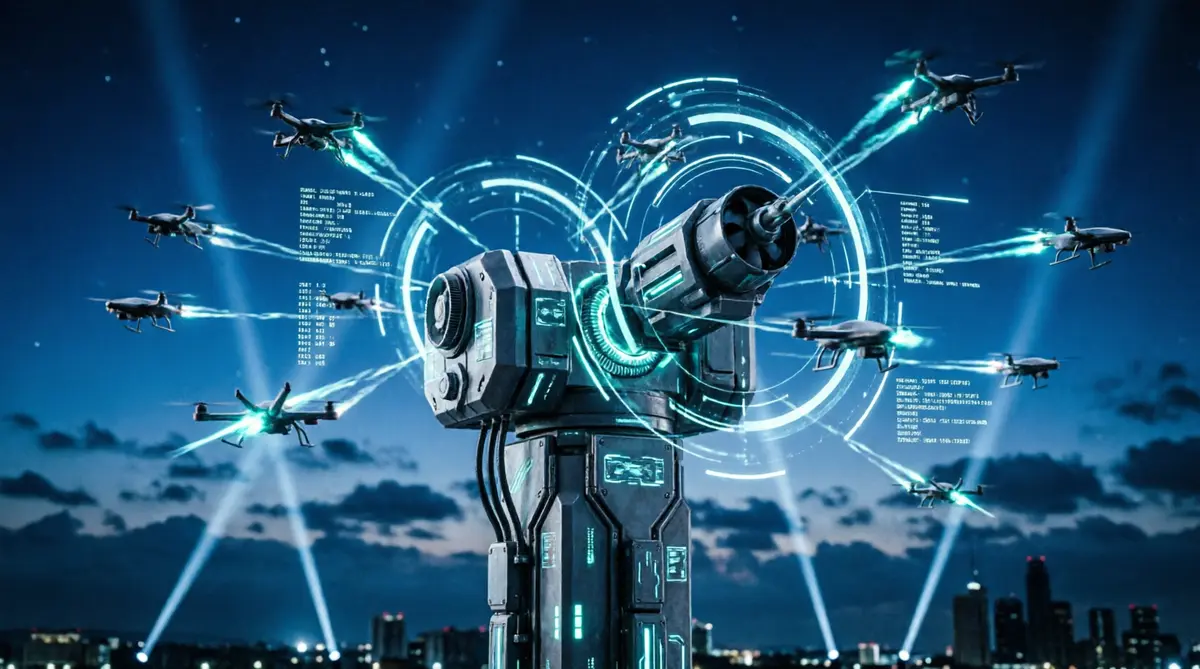
A dozen small, cheap drones arriving at once will overwhelm a manual air-defense team before the crew has even finished counting them. This has become one of the most urgent gaps in modern warfare, and the fix is AI-based fire-control systems that lock onto every drone in a swarm at the same time, rank which ones pose the biggest threat, and direct weapons toward them within a fraction of a second. Work that used to need a full room of analysts now happens on its own in real time, which is why fire-control has become one of the fastest-growing areas in defense technology over the last two years.

Fixing Equipment That Fails Without Warning.
Jets and turbines break down at the worst possible time, usually mid-mission, and they rarely warn you first. Predictive-maintenance AI closes that gap by constantly reading vibration, heat, and wear data, and flagging a weak part days or even weeks before it actually breaks, giving crews time to fix it safely on the ground instead of during an actual mission. This one fix alone — catching failure before it happens instead of after — is quietly saving both money and lives across multiple militaries already.

Fixing Cyberattacks That Move Faster Than People Can React.
A hacking attempt that unfolds in milliseconds is already over by the time a person notices something's wrong. AI closes this gap by watching network activity nonstop and reacting the instant something looks off, shutting the door before a human would even open the alert email. That speed is exactly why cyber defense has grown into one of the biggest AI spending areas in military budgets — it isn't optional protection anymore, it's the only realistic way to keep up with attacks that don't wait for a human response time.

Fixing The Cost Problem Smaller Countries Face.
Good data, testing facilities, and skilled AI talent all cost a lot of money, and a smaller country simply can't outspend a bigger rival on its own. The fix countries have landed on is sharing the load. NATO built DIANA and its Data and AI Review Board specifically so member countries stop solving the same data and testing problems in isolation, and the US runs a similar effort called the AI Partnership for Defense, where allied militaries compare notes instead of each one reinventing the same system from scratch. For a mid-sized military, this kind of partnership is often the actual difference between having a working AI-defense capability and not having one at all.

Fixing The Shortage Of Real Combat Data.
Every one of the fixes above depends on clean, properly labeled, trustworthy data, and there simply isn't enough of it sitting around. Arthur Holland Michel, who studies this at the UN Institute for Disarmament Research, has pointed out that real war is messy in ways no training dataset fully captures. Brookings has documented what that gap actually looks like in practice — Patriot missile batteries, in earlier conflicts, sometimes struggled to tell a friendly aircraft apart from an enemy one, because the training data simply hadn't seen enough of that exact situation. Even China runs into this — Georgetown's CSET reports that Chinese military experts themselves worry Beijing doesn't have enough real combat data, since the country hasn't fought a full-scale war in over forty years, leaving it reliant on drills that don't fully replicate actual combat.
The fix defense researchers have landed on is building the missing data on purpose instead of waiting for a war to produce it. Large-scale simulations and war games are now standard practice, and the Army's Cyber Defense Review has explored using AI itself to generate realistic practice scenarios for cybersecurity and targeting systems to train on. That turns a shortage into something militaries can manufacture themselves — not a perfect substitute for real combat, but the closest thing to it available without an actual war happening.

Fixing The Trust Problem Around Life-And-Death Decisions.
A machine making the wrong call during a life-or-death moment is the risk everyone worries about most, and the fix isn't removing AI from the picture — it's keeping a human firmly in charge of the final decision. NATO's six principles, released in 2021 and updated in 2024 across all 32 member countries, cover exactly this: lawfulness, responsibility and accountability, explainability and traceability, reliability, governability, and bias mitigation. The US runs its own version, the Responsible AI Strategy and Implementation Pathway, which requires systems to explain their reasoning clearly enough for a human operator to question or override them before anything permanent happens. It's a small trade-off — slightly slower decisions — in exchange for a system nobody has to trust blindly.

Fixing The Gap Around Fully Autonomous Weapons.
Neither of those frameworks settles the hardest question — weapons that pick a target and fire without a human ever pulling the trigger. That fight is playing out at the United Nations, inside the Convention on Certain Conventional Weapons, or CCW. A coalition called the Campaign to Stop Killer Robots, backed by more than 260 organizations across roughly 70 countries including Human Rights Watch, has pushed since 2013 for a binding treaty against weapons operating without real human control. In late 2023, 166 countries voted in favor of a UN resolution on the issue, with only three opposed. UN Secretary-General António Guterres, alongside the International Committee of the Red Cross, has publicly asked states to finish a binding treaty by the end of 2026.
The fix being pushed right now is moving the conversation out of the CCW, where every decision needs full consensus and has stalled for over a decade, into the UN General Assembly instead, where a handful of powerful countries can't quietly block progress the same way. The CCW expert group's mandate expires sometime in 2026, with a review meeting scheduled for November, so this shift may happen within the next year. It isn't solved yet, but for the first time there's an actual, specific plan on the table rather than just more talk.
Why All Of This Is Happening At Once.
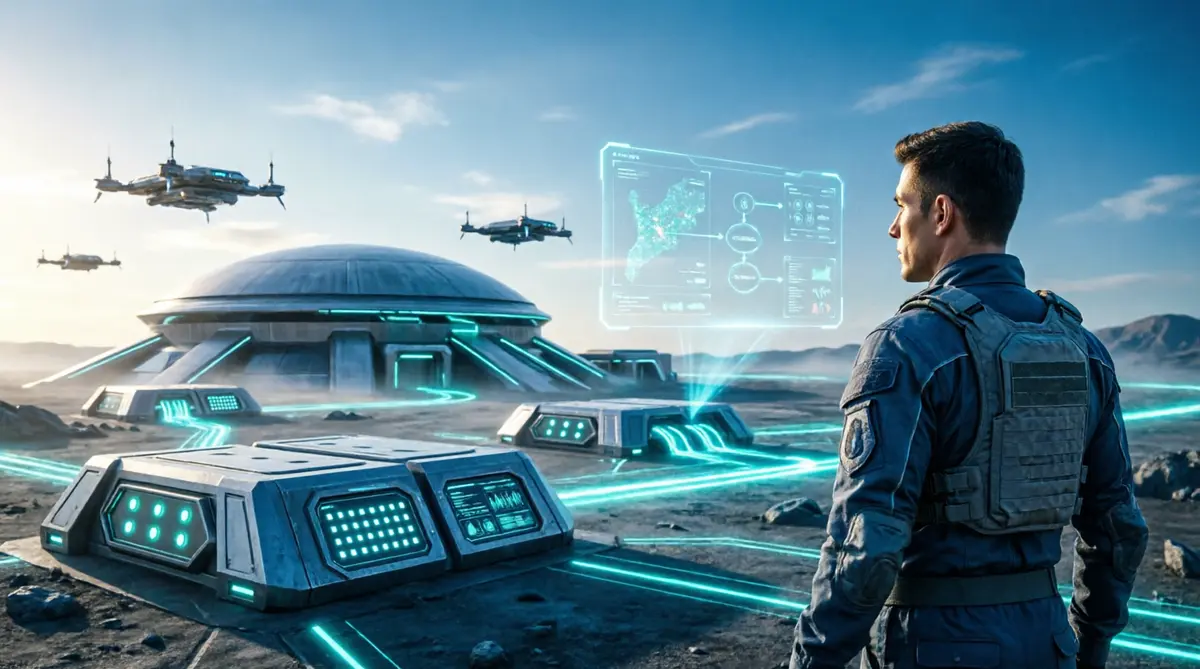
Two forces are pushing these fixes forward at the same time. One is competition — the moment one country closes a gap with AI, its neighbors feel pressure to close the same gap, and that pressure spreads fast across a whole region. The other is necessity, since drone swarms, hypersonic weapons, and cyberattacks that unfold in a fraction of a second don't wait around for a human to catch up. None of this replaces human judgment. It buys people enough time to actually use it.
Where This Leaves Defense Going Forward.
Put together, this is what a stronger defense system actually looks like right now — not a single breakthrough, but a long list of specific problems getting specific fixes. Borders that couldn't be fully watched are now watched in real time. Equipment failures that used to happen mid-mission are now caught early. Cyberattacks that used to slip through are now caught the instant they start. Smaller countries that couldn't build this alone are pooling resources with allies. Even the shortage of real combat data is being closed through simulation instead of left as an excuse to do nothing.
What's still unfinished is the treaty gap around fully autonomous weapons, and that's exactly why the push to move talks into the UN General Assembly matters so much over the next year. Everything else on this list already has a working fix in motion. That one still needs the world to agree on it.