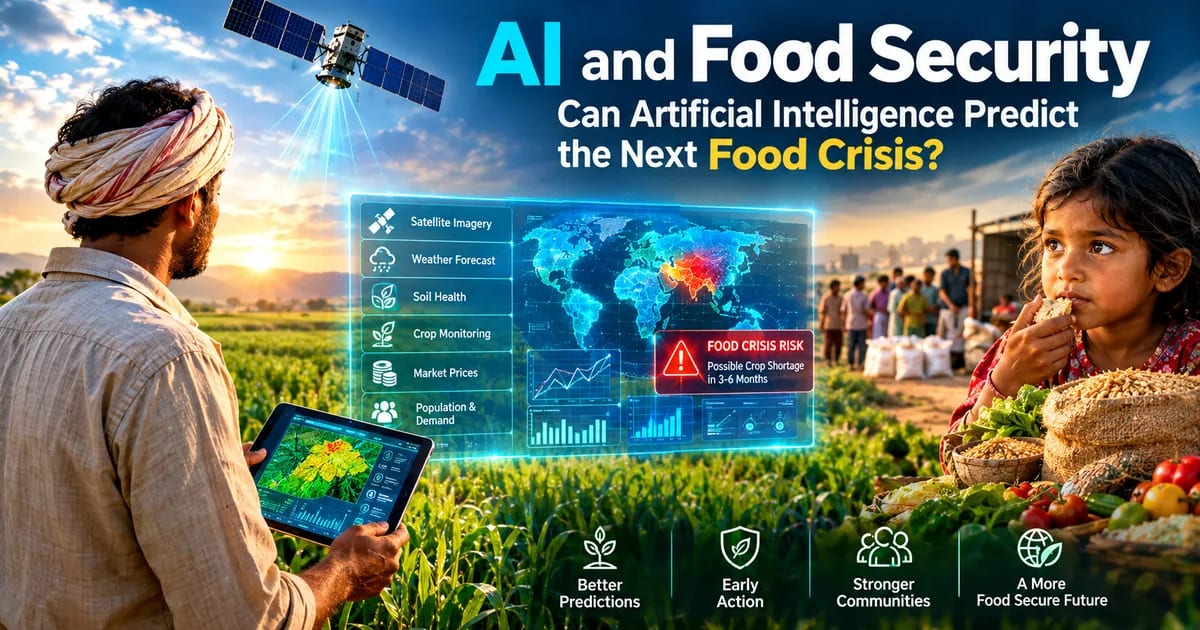
AI and Food Security: Can Artificial Intelligence Predict the Next Food Crisis?
Imagine a farmer in Punjab checking his wheat field after an unusually dry month.
The plants still look alive. The market price is rising. Rain is expected, but nobody knows exactly how much will come. If he waits, he may lose part of his crop. If he spends money on irrigation now, he may waste scarce water.
A few hundred kilometres away, a computer is looking at satellite images, weather forecasts, soil information, crop conditions and market signals.
It sees something the farmer cannot see yet: the possibility of a serious production shortfall.
But there is a bigger question.
What happens when an algorithm predicts a food crisis before people can see it?
And even more importantly: will humans act early enough to prevent it?
That is where the real story of AI and food security begins.
Table of Contents
1. Why Food Crises Are Hard to Predict
2. What AI Can Actually See
3. From Crop Failure to a Food Crisis
4. The Human and Economic Cost
5. The Problem With Trusting the Prediction
6. A New Model: From Prediction to Early Action
7. What Governments, Farmers and Communities Can Do
8. What Happens Next?
9. Conclusion
Why Food Crises Are Hard to Predict
A food crisis rarely begins on the day people start going hungry.
The warning signs can appear much earlier: declining rainfall, crop stress, disease outbreaks, livestock losses, rising food prices, conflict, damaged roads, disrupted trade or falling household purchasing power.
The challenge is that these signals are scattered across different systems.
A satellite sees vegetation.
A weather service sees rainfall.
A market database sees prices.
A humanitarian organization sees household food access.
A farmer sees what is happening in the field.
AI can potentially bring many of these signals together and identify patterns that would be difficult for humans to detect manually.
The need is enormous. The 2026 FAO food-security assessment estimates that about 645 million people experienced hunger in 2025, while around 2.1 billion people experienced moderate or severe food insecurity.
That does not mean AI can simply "solve hunger." Hunger is shaped by poverty, conflict, climate, markets, infrastructure, policy and access to food.
But better prediction could give humans something extremely valuable:
time.
What AI Can Actually See
AI does not see the future like a crystal ball.
It finds patterns in data.
A modern food-security prediction system can combine information such as:
- satellite imagery
- rainfall and temperature
- soil conditions
- crop health
- historical yields
- food prices
- trade information
- population data
- conflict and displacement
- household food-security indicators
The World Bank notes that AI can help predict crop yields and identify early signs of crop stress when satellite, weather, soil and field data are combined. But it also stresses that accuracy depends heavily on local data quality and ground validation.
Recent research shows how quickly this field is developing.
A 2026 study in Scientific Reports used Sentinel-2 satellite imagery and machine learning to estimate wheat yields roughly 50 days before harvest.
Another 2026 study published in Nature Food developed a framework for estimating crop yields globally using remote sensing and geospatial information. The researchers found that early estimates can support decisions around trade and food-security risk, although accuracy varies between regions and conditions.
Pakistan is also part of this story.
A 2025 Scientific Reports study examined AI-based wheat-yield forecasting using satellite, climate and soil information in southern Punjab. The researchers reported useful predictive performance and showed how local agricultural data can be combined with machine learning for earlier yield estimates.
The technology is therefore moving beyond theory.
But prediction is only the beginning.
From Crop Failure to a Food Crisis
Suppose AI predicts that wheat production in a region will fall significantly.
That does not automatically mean millions of people will go hungry.
There is a chain between the field and the dinner table.
Lower production can influence market expectations.
Market expectations can influence prices.
Higher prices can reduce what poor families can afford.
Families may then reduce the quality or quantity of their food.
Governments may need to release reserves, support vulnerable households or adjust imports.
This is why food security is not simply a farming problem. It is a human and economic system.
FAO already operates the Global Information and Early Warning System, which monitors food production, supply, demand and markets and alerts decision-makers to emerging food crises. Its systems also use Earth-observation information to monitor crop conditions.
AI can strengthen this kind of early-warning infrastructure by processing enormous quantities of information faster.
WFP is already moving in this direction. Its 2026 HungerMap Live platform combines food-security information with predictive modelling to help identify where urgent needs may develop.
The important shift is this:
Instead of waiting for hunger to become visible, organizations can increasingly prepare while the warning is still developing.
The Human and Economic Cost
Consider two governments.
Government A discovers a food shortage after prices have already exploded.
Government B receives an early warning months earlier.
Government B may have time to protect vulnerable households, arrange supplies, support farmers, prepare storage and coordinate humanitarian assistance.
That difference in timing can become the difference between prevention and emergency response.
WFP's anticipatory-action programmes are designed around this principle: act before predictable climate shocks become disasters. The organization says its programmes now operate across 47 countries.
Pakistan provides an important example. In June 2026, WFP announced that Pakistan had adopted its first national Anticipatory Action Strategy, designed to use risk forecasts to trigger action before climate-related hazards cause their worst damage.
This is where AI becomes more than a technology story.
A better prediction can influence:
a farmer's decision,
a family's food budget,
a government's emergency plan,
a trader's expectations,
and a humanitarian agency's allocation of scarce resources.
One forecast can travel through an entire society.
The Problem With Trusting the Prediction
Here is the uncomfortable part.
An AI forecast can be wrong.
A model may have excellent historical performance but struggle when conditions suddenly change.
A war can disrupt a supply route that did not exist in the training data.
A new crop disease can behave differently from historical diseases.
A weather pattern can become unusually extreme.
A region may have poor-quality data.
A prediction can also be technically accurate but practically useless if nobody has the money, authority or infrastructure to act on it.
This creates a dangerous temptation: treating an algorithm's output as a decision rather than evidence.
That distinction matters.
AI can estimate risk. Humans must decide what to do about that risk.
There is also an inequality problem.
Farmers with smartphones, connectivity, digital skills and access to finance may benefit first. Farmers without those resources may remain outside the system.
The result could be an unexpected paradox: technology designed to strengthen food security might increase the gap between people who can use advanced information and people who cannot.
A New Model: From Prediction to Early Action
For food security, I would think about AI through a simple five-step model:
SEE → PREDICT → VERIFY → ACT → LEARN
1. See
Collect information from satellites, farms, weather stations, markets and communities.
2. Predict
Use AI to identify possible crop losses, drought risks, disease outbreaks or abnormal price movements.
3. Verify
Compare the prediction with local knowledge and ground observations.
A satellite cannot walk through a farmer's field.
A model cannot know every local reality.
4. Act
If the risk crosses a meaningful threshold, trigger a practical response.
That could mean early cash assistance, drought-resistant seeds, livestock protection, food procurement, water planning or market intervention.
5. Learn
After the event, compare the prediction with what actually happened.
What was correct?
What failed?
Which communities were missed?
Which warning arrived too late?
This final step is essential because an AI system should become accountable through evidence, not simply become more complicated.
What Governments, Farmers and Communities Can Do
The most useful food-security AI system may not be the one with the most impressive algorithm.
It may be the one connected to the strongest human network.
Governments can invest in open agricultural and weather data, local validation systems and early-action funds.
Agricultural departments can make AI recommendations understandable in local languages instead of forcing farmers to interpret technical dashboards.
Farmers can treat AI as decision support rather than an unquestionable authority. A prediction should be compared with field conditions, local experience and financial reality.
Humanitarian organizations can connect forecasts to pre-approved actions. A warning that produces no action is just information.
Researchers should also test models across different regions, farm sizes and climate conditions rather than assuming that success in one location automatically transfers everywhere.
And ordinary citizens have a role too.
Food security is not only about producing more food. It is also about whether people can afford it, whether supply chains function, whether food reaches vulnerable communities and whether society can respond before a shock becomes a disaster.
What Happens Next?
The next stage of AI in food security will probably be less about one magical prediction and more about connected intelligence.
Satellites will monitor fields.
Weather systems will update forecasts.
Markets will reveal price stress.
AI will connect patterns.
Human experts will interpret them.
Governments and humanitarian agencies will decide when to act.
That is a much more realistic future than the idea of a machine predicting the exact date of the next global food crisis.
WFP's current AI strategy already describes AI as a way to improve operational efficiency and frontline response, while emphasizing the broader human systems around the technology.
The most interesting question is therefore not:
"Can AI predict the next food crisis?"
It increasingly can predict pieces of the risk.
The deeper question is:
When AI tells us trouble is coming, will human beings have the courage, resources and systems to act before people begin paying the price?
Practical Action Framework
For any food-security AI project, ask these seven questions:
1. What exactly are we predicting?
2. Is the underlying data reliable and locally relevant?
3. Who checks the prediction on the ground?
4. Who receives the warning?
5. What action is triggered by the warning?
6. Who is responsible if the prediction is wrong?
7. Did the system actually reduce human suffering?
That final question matters most.
A highly accurate model that never reaches a vulnerable community is not enough.
The real measure of success is what happens to human lives after the prediction is made.
Conclusion
AI may become one of humanity's most useful early-warning tools for food security.
It can watch enormous areas, identify patterns, estimate crop yields, monitor prices and help governments and humanitarian organizations see danger earlier.
But an algorithm cannot plant a crop.
It cannot distribute emergency cash.
It cannot repair a broken road.
It cannot negotiate peace.
And it cannot decide whose hunger deserves attention first.
Those remain human responsibilities.
The future of food security should therefore not be AI replacing farmers, governments or humanitarian workers.
It should be AI helping them see earlier, understand better and act faster.
The next food crisis may begin quietly in a field, a weather pattern, a market or a conflict zone.
The technology may help us notice the warning.
What saves people will be what humans do with that warning.