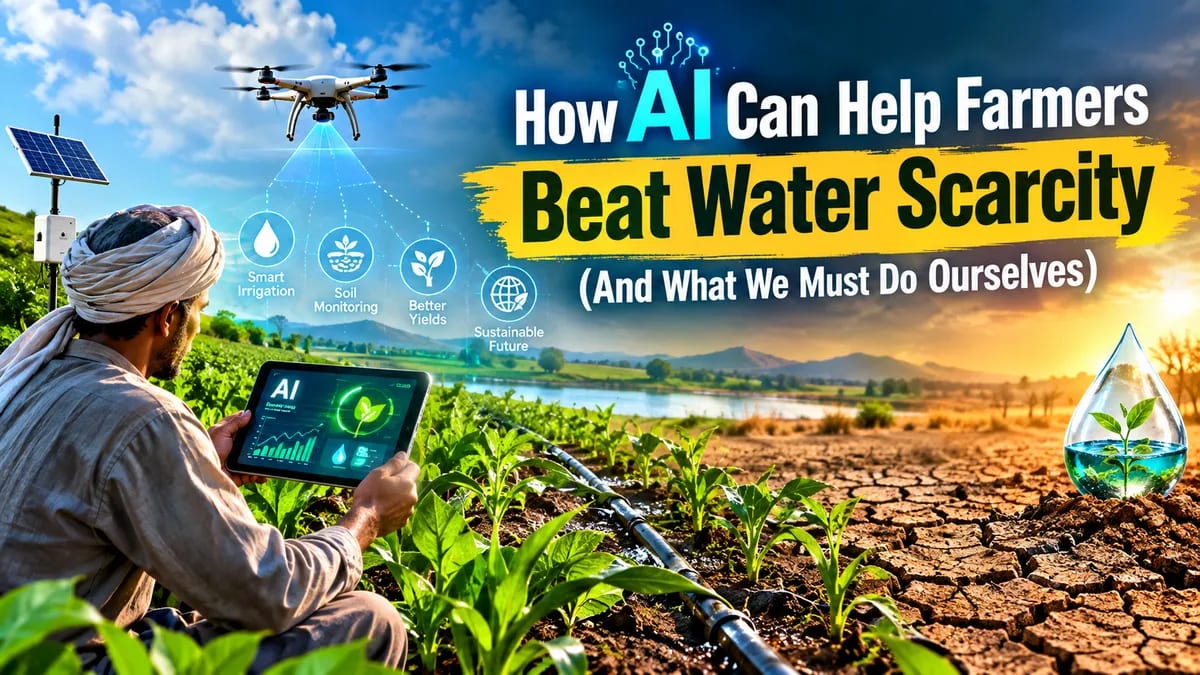
Every Drop Counts: How AI Can Help Farmers Beat Water Scarcity (and What We Must Do Ourselves).
It's 6 p.m. and a farmer is standing at the edge of her maize field with a question she can't shake: *Water tomorrow, or wait?*
Water now, and she may waste the last easy water in her borewell. Wait, and the crop may burn. Her grandmother never had to weigh a choice this tight. (She's an imagined farmer, but her dilemma is real in dry regions everywhere.)
Now imagine a small soil sensor, a satellite image and a weather forecast whispering the answer to her phone. That is what AI is starting to offer.
This article follows one question: When irrigation becomes data-driven, who wins? The farmer, the water, or only the people who own the technology?
In this article,
1. Why the field is where the water crisis is decided
2. What AI really does on a farm
3. The evidence: real numbers, honest limits
4. The trap almost everyone misses
5. Who could be left behind
6. What AI can do vs. what humans must decide
7. The S.M.A.R.T. Water Plan: your action framework
8. The big idea
1. Why the field is where the water crisis is decided
If you want to find where the world's freshwater goes, look at a farm. The FAO reports that agriculture used 72 percent of global freshwater withdrawals in 2020, and that this figure keeps climbing as irrigated land expands. A recent UN report found sixty-six countries sending more than 75 percent of their freshwater to farming.
That's the bad news. Here's the good news hiding inside it: **if farming is the biggest use, farming is also the biggest opportunity.** Small improvements in the field add up to enormous amounts of water.
2. What AI really does on a farm.
Forget robots and science fiction. In the field, AI does three plain, powerful things:
- It predicts. How thirsty will this crop be in three days?
- It notices. A dry patch, a leak, early stress that the eye would miss.
- It advises. "Water the north plot tonight. Skip the south."
Machine learning just means a computer learns patterns from past data instead of following fixed rules. Picture a farmer who has watched ten thousand seasons and never forgets one. That's the idea.
3. The evidence: real numbers, honest limits.
The early results are exciting, and they deserve an honest read.
A Portuguese team built a sensor-driven irrigation system with machine learning and reported water savings of up to 60 percent. A conference study using satellite data and machine learning across several farms reported savings of up to 30 percent with no loss in yield.
Look closely at those words, "up to." These are best-case trial results, not guarantees for every farm. The second one is a conference presentation, not a full journal paper.
The most hopeful work is aimed at small farmers. Researchers in South Africa's Vhembe District built a satellite-and-AI tool for smallholder maize growers, and a prototype turned its predictions into field-level water alerts. It's a prototype, not yet a service in millions of pockets. But it proves the direction is real.
4. The trap almost everyone misses.
Here's the idea that could change how you think about this whole topic.
Imagine AI helps every farmer in a valley use less water per crop. Victory? Not necessarily. A 2018 paper in Science by Grafton and colleagues found that higher irrigation efficiency rarely delivers more water for everyone. Farmers often use the savings to irrigate more land or grow thirstier crops. Also, water "wasted" in one field often flows back to rivers and aquifers where others depend on it.
Their conclusion is a blueprint: efficiency must come with honest water measurement, a cap on total extraction, and an understanding of how irrigators behave.
That paper is about irrigation efficiency in general, but AI is an efficiency tool, so the warning fits. A smarter tap won't refill an empty aquifer. Fair rules about total use will.
5. Who could be left behind.
Technology never lands evenly. Sensors, phones, data plans and training all cost money. So watch for these risks:
A widening gap. Big farms adopt first and pull further ahead. A two-hectare farmer may never get the chance.
Data control. Who owns the readings from your land? Could they one day affect your loan or your price?
Broken trust. One wrong recommendation that costs a harvest can end a farmer's faith in the tool.
Fading wisdom. If everyone follows the app, knowledge of clouds, soil and leaves could quietly disappear.
These are risks based on how technology spreads in general, not proven outcomes. But they're worth naming before they happen.
6. What AI can do vs. what humans must decide.
AI can: forecast crop thirst, flag stress early, cut wasted watering, and crunch more data than any person could.
Humans must decide: which crops a dry region should grow, how water is shared between farms, towns and rivers, who is protected in a drought, and who is accountable when advice fails.
If a model sees a shortage coming and nobody warns the village, that isn't the machine's failure. It's ours. So keep one line in your head: AI should amplify human ability, never erase human responsibility.
7. The S.M.A.R.T. Water Plan.
This is my own original checklist, not an established scientific model. Use it before trusting any AI water tool.
S: Start with one clear problem. Are you short of water, money, or both? Name the exact decision you need help with.
M: Measure your baseline. Record one season of current water use. If you can't measure the "before," you'll never prove the "after."
A: Ask who owns the data. Where is it stored? Who can see it? Get answers in writing.
R: Run a small trial. Test on one plot beside a traditional plot. Compare water, yield and cost.
T: Team up. A cooperative can share the cost of sensors and training. A local adviser can translate the numbers into plain language.
For governments and water boards, add one more step: pair every efficiency tool with a limit on total extraction, so saved water isn't simply spent on expanded farming.
For students, teachers and everyone else: you have a role too. Ask where your food's water comes from. Support local water-measurement projects. Learn one simple tool, such as a free weather or satellite app, and show a farmer near you.
8. The big idea.
Can algorithms solve agricultural water scarcity? They can be one of the strongest tools we've ever had, but a tool only works as well as the hands and rules around it.
AI can tell a farmer how much water her crop needs tomorrow. It can't tell a valley how much water it should use at all. That answer belongs to farmers, communities and governments, and they have to give it together.
So here's the future worth building: a farmer with a better tool, and a real say in the rules. And a question worth asking now, before software quietly starts making these calls: *ten years from today, will the people who live off this water still be able to ask why, and get an answer?*
References.
FAO, The State of the World's Land and Water Resources for Food and Agriculture 2025 (72% of withdrawals): https://openknowledge.fao.org/server/api/core/bitstreams/889f7d6d-4d61-40eb-88f9-fddfc44bc817/content/state-of-the-worlds-land-and-water-resources-for-food-and-agriculture-2025-2025/scenarios-offer-insights-assumptions.html
UN News, December 2025 (66 countries above 75%): https://news.un.org/en/story/2025/12/1166582
Glória, Cardoso & Sebastião (2021), Sensors 21(9): https://www.mdpi.com/1424-8220/21/9/3079
8th International Electronic Conference on Water Sciences (conference abstract): https://sciforum.net/paper/19120
Smallholder maize EO-AI study, Vhembe District, South Africa (Frontiers): https://dea.lib.unideb.hu/bitstreams/91625880-5429-4bab-bbfc-c0b68286ef4a/download
Grafton et al. (2018), "The paradox of irrigation efficiency," Science 361: https://doi.org/10.1126/science.aat9314.